
The Elite’s Hush-Hush New AI Hearing Aid That’s Turning the Industry Upside Down
The Elite’s Hush-Hush New AI Hearing Aid That’s Turning the Industry Upside Down
An open secret is buzzing through private dinners, exclusive salons, and high-society cocktail mixers among New York City’s most powerful upper crust. It’s passed between Wall Street titans, A-list Hollywood stars, and professional sports team owners in hushed asides. The question on everyone’s lips? Have you heard of Fortell?
Most people haven’t—even if they caught a mention, overlapping conversation at noisy events usually makes the name unrecognizable. But once they learn what it is, especially if they’re baby boomers with age-related hearing loss, they want it badly. Fortell is a new AI-powered hearing aid that claims to deliver a dramatically better listening experience than any existing product. The small group of beta testers who’ve tried it say it outperforms every high-end device they’ve struggled with for years.
These testers have made trips to Fortell’s headquarters on the fifth floor of a SoHo WeWork, where they get custom fittings for the teardrop-shaped over-the-ear devices, which look nearly identical to standard models from the outside. The real reveal happens when a Fortell employee walks them down to the busy street. Amid honking cabs, street noise, and delivery trucks idling outside luxury boutiques, testers are asked to hold a conversation with a Fortell staffer, while two other employees stand behind them adding overlapping loud chatter to the urban chaos.
Even with all that background din, testers can clearly understand every word the person in front of them says. The fog clears. For many, it’s life-changing. “This was so incredible that I burst into tears,” says Ashley Tudor, one of the few non-famous beta testers (though she is married to a venture capitalist).
Among people living with age-related hearing loss, getting a spot in the Fortell beta has become an unexpected status symbol—the hearing aid equivalent of a limited-edition Hermès Birkin bag. “This product has become a major flex for the post-70 crowd,” says one investor. When entertainment lawyer Allen Grubman got his through an investor connection, he started getting calls from dozens of “very substantial” people begging for access. “They said, ‘Allen, we hear that you have these new great hearing aids,’” he recalls, noting every caller wanted to know how to get their own. Those who’ve wangled a beta spot include multiple Forbes 400 billionaires, a chart-topping musician, a hit TV producer, and Hollywood A-listers of all ages. KKR private equity co-executive chair Henry Kravis raves about his Fortells, as does actor and comedian Steve Martin, a beta tester.
One of Martin’s friends, character actor Bob Balaban, suffered permanent significant hearing damage on a movie set years ago and hated every hearing aid he’d tried. Envious of Martin’s access to the cutting-edge device, he despaired of ever getting fitted himself. “God. I wish I had Steve’s hearing aids,” he told his wife. “But I think they’re movie-star hearing aids. I don’t think they’re character-actor hearing aids.” Fortunately for Balaban, he ultimately made the cut.
The Fortell team says they hope eventually anyone who needs a hearing aid will be able to try one. The product launches to the public this month—but only at one single location, and it already has a daunting waiting list. It’s easier to get your hands on limited-edition Marty Supreme streetwear than a pair of Fortells right now. The retail price is set at $6,800.
The Origin Story: A Personal Mission Fixing a Broken Industry
Fortell grew out of co-founder and CEO Matt de Jonge’s experience with his own grandparents. “Four times, I watched them lose their hearing, get fancy expensive hearing aids, and just drift away from the family,” de Jonge says. His grandparents followed a depressingly familiar trajectory: at first, they asked people to repeat themselves, but the constant repetition grew frustrating for both sides. Eventually, they stopped asking, and tuned out of conversations they couldn’t follow. As de Jonge learned, the isolation that followed sped up their cognitive decline and led to dementia. He still remembers holiday dinners where the whole family, including him, ignored his grandparents. “I had given up on them,” he says. “I feel like I have blood on my hands for that.”
At the time, now 37-year-old de Jonge worked on the AI team at the giant hedge fund Bridgewater Associates. He started researching what it would take to build a better hearing aid in his nights and weekends. The global hearing aid industry is worth nearly $14 billion, but the small handful of major players have never managed to build products most users actually love. (While some disagree: WIRED’s own testing has found existing models worth recommending.) One 2007 study, replicated in 2013 right around the time de Jonge started his research, found that 80% of adults between 55 and 74 who would benefit from hearing aids don’t use them—including many who already own a pair. Barriers range from cost and comfort to the widespread perception that the devices just don’t work well enough.
De Jonge quickly pinpointed the core unmet need: helping people follow conversations in busy social settings, the place hearing matters most. Most existing hearing aids only amplify sound and apply basic noise reduction, which does nothing to solve the problem in crowded spaces. “It’s not about making sounds louder,” de Jonge explains. “People with age-related hearing loss have lost the innate ability to focus on the sounds that are important to them.” The hardest scenarios are restaurants and parties with multiple overlapping conversations, a challenge the industry calls the “Cocktail Party Problem.” Even people with normal hearing struggle here, but those with hearing loss are completely lost in the noise, and even expensive devices barely help. Back then, de Jonge didn’t have a solution, so he put the project aside.
That early work pushed him to explore how AI could solve other medical problems. He left Bridgewater to join Butterfly Network, a startup that built an AI-powered ultrasound sensor called Butterfly IQ, marketed as “ultrasound on a chip.” He worked his way up to vice president of product, and his shares became liquid when Butterfly went public in 2021.
Soon after, de Jonge and his former Bridgewater colleague and college roommate Cole Morris started working on an idea from Joshua Kushner, founder of VC firm Thrive Capital and key investor in health insurance startup Oscar Health. Kushner was exploring buying an operating hospital to use as a test bed for new software that would drastically improve hospital efficiency. After four months of talking to doctors about gutting the hospital’s existing software, both men got cold feet. “After four months of talking to doctors about buying a hospital and ripping out all its software, I realized I could accidentally get someone killed,” de Jonge says. Around the same time, his aunt called him out for abandoning his original hearing aid project—his own family’s next generation was already dealing with hearing loss. “Weren’t you supposed to build a better hearing aid?” she asked him.
That question hit home. His time at Butterfly had shown him that AI was now powerful enough to tackle bigger, harder problems. He and Morris told Kushner they wanted to scrap the hospital project and launch an AI hearing aid company instead. Kushner agreed to fund them immediately. “A lot of people think AI is just for making businesses more efficient,” he says. “But most people haven’t wrapped their heads around the fact that AI can make consumer products exponentially better.”
The pair originally named the startup Chromatic, before rebranding to Fortell. They identified two core components needed for a transformative hearing aid: first, cutting-edge AI to build a better algorithm that can isolate and amplify specific conversations; second, a custom-built chip that can run that algorithm in real time.
Building a Better Hearing Aid From the Chip Up
The AI work went to Igor Lovchinsky, Butterfly’s former AI lead. He’d switched careers later in life: until his mid-20s, he was a Juilliard-trained concert pianist, but left music to pursue science. Lovchinsky argues that most other hearing aid companies overhype their AI claims—they’re just slightly adjusting amplification or shifting microphone direction, he says, not actually doing anything transformative.
“What we realized we needed was source separation,” he explains. “Take an audio signal that has both the speech you want to hear and the noise you don’t, and split them into completely separate streams of pure speech and pure background noise.” Back in 2021, even that wasn’t proven possible. “Our brains have an incredible neural network honed by billions of years of evolution to recognize natural speech,” he says. “If your source separation is even slightly off from how natural speech sounds, your brain will pick up on it instantly.”
As co-founder and chief scientific officer, Lovchinsky and his team built AI tools to identify the unique “audio fingerprint” of voices speaking directly to the wearer, clean up the signal, and deliver it to the wearer as if they were talking in a quiet room.
Great algorithms are useless without a custom chip that can run them fast enough. Fortell hired another Butterfly alum, Andrew Casper, a former lead engineer on Google’s AI chip team, as CTO to lead the silicon work. Casper also wasn’t sure the task was possible at first. “Your ear is extremely sensitive to lag,” he explains. If the processed sound doesn’t come back in under 10 milliseconds—one one-hundredth of a second—users get a disorienting uncanny valley effect that makes the audio feel wrong. “We didn’t even know if we could do it in that time frame with high enough fidelity that users wouldn’t notice distortion,” he says. Only after solving that could the team tackle the final hurdle: fitting the whole system into a hearing aid small enough to wear on the ear.
It took years for the startup to get the technology right before they could even test on human users. Fortunately, the $9 million initial seed round, most of it from Kushner, gave them enough time to work without pressure. “For the first few years of the company, you couldn’t even see a working hearing aid,” de Jonge says. “We had to build everything from scratch just to figure out if the science was even possible.”
By 2023, Lovchinsky and Casper had made major breakthroughs. Lovchinsky’s team found that separating voices required building a proprietary version of the industry’s Spatial AI, which builds a 3D map of the surrounding environment. “It pulls data from multiple microphones and works the same way healthy human hearing does, using input from both ears to figure out where sound is coming from,” he says. The team also found a way to train their AI models on massive amounts of synthetic data that replicated every possible listening environment. “That makes it especially effective in the hardest listening situations,” he says.
More funding rounds followed, with a total of $150 million invested to date. The Series B round was co-led by Antonio Gracias, best known for his early work with Tesla and his role in the Department of Government Efficiency. Gracias brought his Tesla scaling experience to advise Fortell, and the product is personal for him: his sister is a dentist who developed hearing loss from constant exposure to drill noise. After de Jonge gave him the famous street demo, Gracias says “Even with construction going on behind me, I could hear Matt perfectly clearly. It literally brought me to tears.” His sister is now a beta tester.
Another early investor is Trae Stephens, partner at Founders Fund. Stephens, 42, has generally good hearing, but had started struggling to follow conversations in noisy rooms. He was blown away by his demo. “Honestly, it’s the best hardware demo I’ve seen in my 11 and a half years at Founders Fund,” he says. “If I can wear these to a loud coffee shop for a meeting, it would change my entire work life.”
Early demos happened before the custom chip was ready. Early testers wore a clunky rig of headphones wired to a laptop that processed the audio off-device. “We’d set up in coffee shops and restaurants, apologize to the waitstaff, explain we were testing new hearing aid tech, and most of them let us stay,” Morris says.
De Jonge privately put together a list of high-profile potential beta testers. He didn’t know for sure if they had hearing trouble, just that they were in the age range where most people develop some hearing loss. One of the first testers was KKR’s Henry Kravis, an early investor who had tried dozens of hearing aids over the years. He was so impressed that he increased his investment to $6.2 million, and connected the team to more high-profile testers. He sent his friend, fellow art collector Steve Martin, to the SoHo office for a fitting.
“I’ve tried so many brands of hearing aids, and they’re good—but they’re not this good,” Martin explained in a Zoom interview. After he did the street test in SoHo, he tried them out with his wife and daughter at their favorite restaurant, with de Jonge sitting several tables away running the processing laptop. The real game-changer came at a cocktail party.
“I was at a party upstairs in my building, and I was wearing my old hearing aids,” he recalls. “I was sitting talking to four people, and I realized I couldn’t understand a single one of them. Then I remembered I had the new Fortells. I went downstairs, swapped them in, came back, and I could hear everyone perfectly.” Now he wears them all the time, and even joked about hearing aids during Saturday Night Live’s 50th anniversary special. “I don’t even think about how it used to be,” he says. “I used to dread going out to restaurants, and now I don’t.” His friend Bob Balaban, once he got into the beta, feels the same way. “This is a massive improvement over the ridiculously expensive devices I was using before,” Balaban says.
The Verdict: Is It Really Worth the Hype (and Price Tag)?
Many other influential users haven’t gone public, but de Jonge confirms most are household names. With only a few dozen beta units available, dozens of powerful people have been pushed to a waiting list. Balaban’s wife, Lynn Grossman, remembers a Labor Day dinner with more than 100 mostly older guests in a private restaurant dining room. She estimated only her husband and another guest, a famous fashion CEO, could hear clearly—all thanks to Fortell. “After the dinner, Bob got 12 or 14 emails from people asking, ‘How do I get these hearing aids?’” she says.
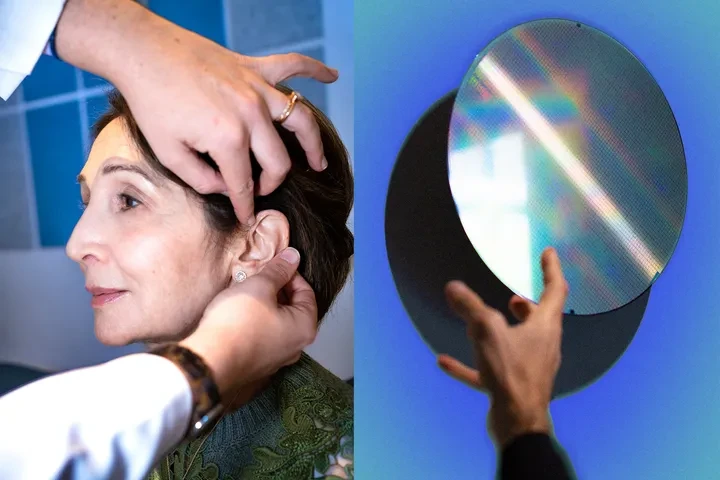
Now that the product has launched, Fortell sells it exclusively at a single clinic on Manhattan’s Park Avenue. The space is designed like a high-end lounge, with devices displayed in the sleek, minimalist style popularized by Apple retail stores. A silicon wafer with the custom chip’s circuitry hangs on the wall as a display piece. Early on, the clinic’s four audiologists will only see a couple dozen customers a week to keep quality high. As the company ramps up production, supply will remain limited for the foreseeable future.
This exclusive launch has raised questions: de Jonge’s original mission was to help people like his grandparents, but for now, the product is only accessible to the wealthiest 1%. When asked how he plans to scale Fortell to make it accessible to the general public, his answer is vague, whether that’s because of unannounced future plans or a lack of a concrete solution. To be fair, Fortell hasn’t inflated the price of premium hearing aids: $6,800 is actually slightly cheaper than many other prescription high-end models, and the price includes professional fitting and ongoing audiologist support. Even so, the price puts it out of reach for most Americans. A harsh reality: most Medicare plans and many private insurance plans don’t cover hearing aids, a policy that leaves millions isolated from conversation, cut off from loved ones, and at higher risk of dementia.
It’s still unclear if Fortell’s technology will ever make its way into cheaper over-the-counter hearing aids, which became widely available after a regulatory shift during the Biden administration. That category includes Apple’s AirPods Pro 2 and other consumer electronics devices, which help with mild hearing loss but don’t perform as well as high-end prescription devices with professional support. Fortell’s model requires extensive testing and custom tuning over time as users adjust to the devices, so the company will focus on its premium white-glove model for at least the next year. After that, it plans to open a small number of additional clinics in select cities, and only much later will it consider expanding to let other retailers sell the technology.
Readers will rightfully ask: is this just a paid puff piece? Is Fortell really that good? Measuring hearing quality is subjective, but Fortell has sought to scientifically prove its product outperforms competitors. The company partnered with researchers at NYU Langone’s audiology and neuroscience departments to run a blinded head-to-head study comparing Fortell to the leading AI-powered competitor, Swiss brand Phonak—whose devices are considered the gold standard in the industry, retail for around $4,000, and were labeled just as the “control group” in the study.
The test simulated the Cocktail Party Problem, with noise coming at random intervals from three different directions. “This setup is perfect for highlighting Fortell’s advantages, because the product’s whole purpose is to extract the signal you want and get rid of the rest,” says Mario Svirsky, the Noel L. Cohen Professor of Hearing Science at NYU School of Medicine, who consulted on the study (and was compensated for his time).
Svirsky says the study’s goals and metrics were set in advance before any testing began. If Fortell had delivered a 4-decibel improvement over the competitor, that would have been a resounding win. When the results came in, Fortell outperformed Phonak by 9.2 decibels. “The results were overwhelming,” Svirsky says. “I’ve never seen such a clear-cut result in my entire career.” On a graph plotting improvement, Fortell’s line towered over Phonak’s. The study concluded that “In the most challenging multi-talker environments, participants had 18.9 times higher odds of understanding speech correctly versus the top AI hearing aids on the market today.”
Naturally, I reached out to Phonak for comment on the results. Michael Preuss, lead audiologist for Phonak’s AI platform, has worn hearing aids since he was 3 years old. Preuss notes Phonak has been in the hearing aid business for 75 years, has used AI in its products for 25 years, and has been developing its own custom AI chip for seven years—just like Fortell. Phonak launched its latest AI system last year to widespread acclaim and adoption. When told an unknown startup had handily beaten his company’s product in a head-to-head, he was unphased. “We’ve seen over and over that there’s no industry standard for how these studies are set up and how measurements are taken,” he says. “You can