
When a Mathematician Brought Set Theory to the Pope
When a Mathematician Brought Set Theory to the Pope
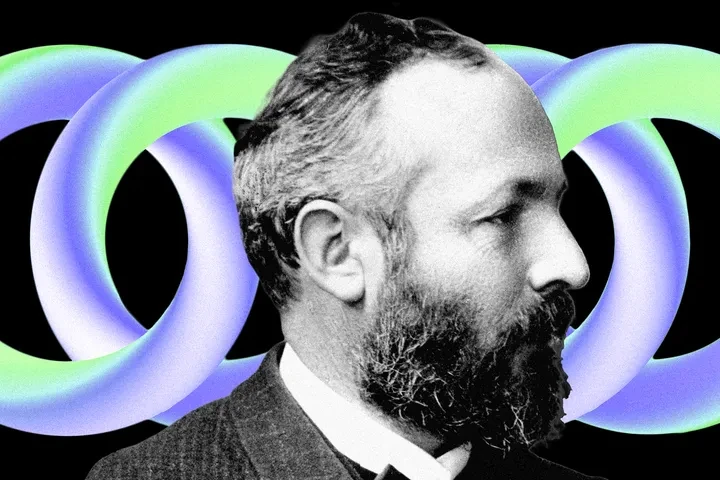
While most casual observers likely missed the connection this year when Leo XIV assumed leadership of the Catholic Church, for students of history and mathematics, his ascension evoked a striking coincidence: the last time a Pope named Leo occupied St. Peter’s Chair in the Vatican, between 1878 and 1903, the modern understanding of infinity was born. That breakthrough came from Georg Cantor, whose entirely original “naïve” set theory upended mathematics, sparking equal parts revolution and resistance. The field split sharply, with some scholars celebrating his radical new ideas and others rejecting them outright.
Cantor was deeply hurt by the fierce pushback against his work, of course, but he never lost faith in his own theories. Why? He held an unshakable conviction that his insights came directly from the divine, that he had a direct line to the absolute on a mission from God—much like the Blues Brothers’ Jake and Elwood. So by 1883, disillusioned with the mathematical establishment, he turned to a new audience: Pope Leo XIII’s Catholic Church.
This was late in Cantor’s life, a period where his mental stability began to fray. He developed what I term an Isaac Newton complex: a pathological aversion to publishing, fueled by paranoid certainty that his peers were plotting to undermine him. In his view, they were either a crowd of backstabbing ignoramuses who failed to grasp his work, or worse—jealous of his singular genius, resenting him for his outsize talent. (Newton himself withdrew from publishing for years after facing harsh criticism of his early work.)
“My own inclinations do not urge me to publish,” Cantor wrote in 1887, echoing Newton’s sentiment from two centuries earlier. “And I gladly leave this activity to others.”
Over the following years, Cantor turned increasingly to new audiences and worked to win support from Catholic leadership. The 1880s marked an era when the Catholic Church was growing more engaged with scientific discovery than ever before. Leo XIII, who took the papacy in 1878, had a particular fascination with science, especially cosmology. He argued that science was a path of progress for the Church, and even personally oversaw construction of a dedicated astronomical observatory at the Vatican, stocking it with cutting-edge modern equipment and employing a team of professional astronomers.
Cantor believed the Church had much to gain from his work, just as his work could benefit from the Church’s support. He wanted Catholic leadership to embrace his ideas because set theory offered a new framework for understanding the infinite nature of the divine—even a mathematical window into the mind of God. Surely that was an idea worth considering?
It would prove to be a very hard sell.
Cantor shared his work with Cardinal Johannes Franzelin, one of the leading Jesuit theologians of the era and a participant in the Vatican Council. On Christmas Day 1885, Franzelin wrote back to say he was grateful to receive Cantor’s work. “What greatly pleases me,” he noted, was that the work “appears to take not a hostile, but indeed a favorable position with regard to Christianity and Catholic principles.” That said, Franzelin added that Cantor’s ideas were likely indefensible, and “in a certain sense, although the author does not appear to intend it, would contain the error of pantheism.”
Cantor replied just after New Year’s Day 1886, reassuring Franzelin that set theory was fully compatible with Catholic doctrine. He explained there are only two distinct categories of infinity: one belonging to God, and one accessible to humans. The Infinitum aeternum increatum sive Absolutum—the eternal, uncreated absolute infinity—was beyond human reach, reserved entirely for the divine. The second, entirely separate Infinitum creatum sive Transfinitum—the created, transfinite infinity—was the domain of human inquiry.
The cardinal replied politely a few days later, skipping over Cantor’s explanation of the two infinities entirely to address only one minor point at length. He thanked Cantor for his thoughtful letter, and acknowledged that as far as he could tell, “no danger for religious truths lies in your concept of the Transfinite.” Even so, Franzelin added, he was far too busy to continue the correspondence: Please do not write to me again, he asked.
Cantor did not give up, and reached out to other Church leaders to win them over. He wrote to a Catholic priest named Ignatius Jeiler, arguing the Church had a responsibility to engage with his ideas. He also contacted a Dominican priest in Rome who was closely studying Cantor’s book Grundlagen and working to unpack its theological implications. “From me, Christian philosophy will be offered for the first time the true theory of the infinite,” Cantor told him.
While these overtures to Catholic authority would normally be considered unusual for a mathematician—especially one who was not Catholic—they were far from the strangest quirk of Cantor’s later life. He also poured energy into proving that English philosopher Francis Bacon was the secret author of all of William Shakespeare’s plays, an elitist conspiracy theory that has existed almost as long as Shakespeare’s work itself. Even today, alternative Shakespeare authorship theories abound: the Earl of Oxford, Christopher Marlowe, the Earl of Derby have all been floated as the “real” Shakespeare. At its core, this claim is an arrogant one, rooted in the irrational belief that a working-class, low-born artist could never have produced such masterful writing.
Even as cracks in Cantor’s mental state grew wider, he had loyal champions in mathematics. German mathematician David Hilbert was particularly enthusiastic about Cantor’s set theory, because it aligned with a tool called the pure existence proof: an invaluable technique developed in the late 19th century that can confirm a mathematical proposition is true without explicitly constructing a concrete example of it. Hilbert had fallen in love with this approach as a college student, when he watched German mathematician Ferdinand von Lindemann earn a prestigious chair at the University of Königsberg after using a pure existence proof to demonstrate the “transcendence” of pi—meaning pi is not the root of any non-zero polynomial with rational or integer coefficients. Lindemann proved pi is transcendental by showing the idea that it was not led to a logical contradiction.
Hilbert later used the same approach to solve a long-standing problem known as Gordon’s theorem, named for mathematician Paul Gordon, who had only ever been able to prove a narrow special case of his own hypothesis. For 20 years, mathematicians across Europe could not extend Gordon’s proof beyond that limited case. In 1888, Hilbert cracked the problem with a completely new approach using the pure existence proof. One of his students later described the achievement with the Latin phrase ex ungue leonem—you know the lion by its claws. That cat, it turned out, had very sharp teeth.
Initially, Gordon attacked Hilbert’s revolutionary work specifically for its reliance on a pure existence proof, famously saying: “This is not mathematics, but theology.” Later, after confirming Hilbert’s proof was correct, he conceded the point, and joked in his apology: “I have convinced myself that theology also has its merits.”
In the 1890s, Cantor distracted himself from his struggles by devoting countless hours to the Society of German Scientists and Physicians. The organization inspired him to launch a new society focused exclusively on mathematics, the Deutsche Mathematiker Vereinigung (German Mathematical Society), which held its inaugural meeting in 1891.
At that first meeting, Cantor laid a trap for his longtime critic, mathematician Leopold Kronecker, preparing to present his brilliant, original method of diagonalization to prove that the “large infinity” of real numbers—the uncountable set labeled ℵ1—is indeed a nondenumerable infinite set. Some of Cantor’s biographers suggest he may have invented the diagonalization method solely to humiliate Kronecker, and even that his core motivation for founding the Deutsche Mathematiker Vereinigung in the first place was to create a public stage to goad Kronecker into an open confrontation—framing the dynamic as something of a 19th-century Hamlet retold as farce. Cantor would then counter Kronecker’s criticism with his diagonalization argument and other technical proofs, embarrassing him in front of the entire mathematical community. Cantor’s own personal letters lend some credence to this account. “Many who were previously blinded would have their eyes opened for the first time,” he wrote, looking ahead to the society’s first meeting where his trap would be sprung, just as any dramatic hero like Hamlet would plan. Theory or not theory!
But the confrontation, if that was indeed Cantor’s plan, never came to pass. Weeks before the meeting, Kronecker’s wife was severely injured in a mountain climbing accident, and she died shortly before the gathering. Kronecker could not attend, and instead sent a brief, warm, friendly letter. The assembled founding members read the letter aloud, and voted Kronecker onto the organization’s board of directors. He never took up the post, however: Kronecker died just a few months later.
After Kronecker’s death, Cantor’s work to build a connected, international community for mathematicians paid off in a major way. The First International Congress of Mathematicians was held in Zurich in 1897, and by that point, most mathematicians had come around to fully recognizing the power of Cantor’s set theory. In the conference’s opening remarks, the plenary speaker publicly honored Cantor’s contribution, calling set theory an enormous achievement for the field. The recognition inspired Cantor to dive back fully into mathematics in the final years of the 19th century, and he soon published what his biographers call his best-known and most complete work: two papers that laid out the core of set theory, its founding principles, and its implications “in an almost perfect logical form,” as mathematician Philip Jourdain would write in 1912.
These two papers would turn out to be Cantor’s last great contribution to mathematics, and many more challenges lay ahead. Major technical flaws in the foundations of set theory began to emerge: logical contradictions known as paradoxes that seemed to threaten the entire integrity of the field. The first, discovered in 1897 by Italian mathematician Cesare Burali-Forti, is now known as the Burali-Forti paradox: if you construct a set of all possible ordinal numbers (the numbers that rank ordered sets as first, second, third, and so on), that set itself would have to contain an ordinal number larger than every ordinal in the set—a logical contradiction. Cantor himself soon discovered another contradiction, which became known as Cantor’s paradox. These troubling discoveries added to Cantor’s existing distress over his continued failure to prove his famous continuum hypothesis.
“My theory stands as firm as a rock,” Cantor once wrote. The same could not be said for his mental health. Cantor suffered greatly in his final years, spending periods of his life in and out of psychiatric clinics for the rest of his days. Even so, he never wavered in his conviction that God had guided his work. At one point, he claimed he had been “logically forced” to discover set theory, “Almost against my will,” he said. He was certain mathematicians would one day embrace his work—and he was right. Today, set theory is a foundational cornerstone of mathematical logic.
Excerpt adapted from The Great Math War: How Three Brilliant Minds Fought for the Foundations of Mathematics by Jason Socrates Bardi. Published by arrangement with Basic Books. Copyright © 2025 Jason Socrates Bardi.