
The Shark Myth and the Old Transatlantic Cable That Built the Modern Internet
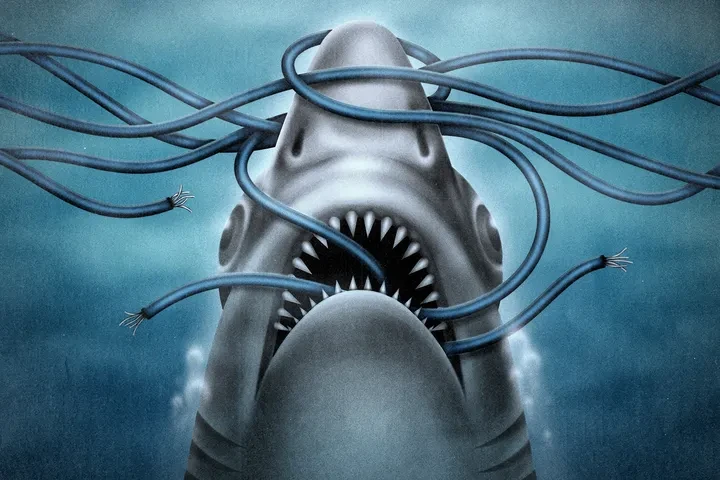
The Shark Myth and the Old Transatlantic Cable That Built the Modern Internet
Sharks have gotten a bad rap. Despite decades of popular myth, they are not out here gnawing through the global internet’s undersea backbone. As a group of cartilaginous ocean fish, sharks are almost entirely blameless for any alleged attacks on the web of fiber-optic cables that crisscross the world’s seabeds.
The engineers and offshore crews that build and maintain the nearly 600 subsea cables carrying almost all cross-border digital traffic—powering every tap, swipe, Zoom call, and endless doomscroll across the globe—have long tolerated this persistent myth with a mix of fondness and frustration. They’d probably roll their eyes at me leading with it, too.
It’s true that if a cable hangs loose above the seabed, a curious shark might gum it while exploring. Sharks have also been known to lunge at cables being hauled up to the surface. But for a shark to actually damage a working cable? You’d have to wrap the cable in fish first—like hiding a pill in a piece of cheese to trick your dog into taking it. On land, rats are a far more real threat: their incisors grow nonstop, so they gnaw on soft cables to wear them down. But no one ever writes headlines about rat cable damage. As one of my friends put it, “sharks make a story cool, rats just make you sound like you have a pest problem.”
These days, people more often ask about satellites, or (living here in Sweden, I get this question a lot) about alleged sabotage of cables in the Baltic Sea. But historically, nothing has grabbed public attention quite like shark bite claims. The myth itself dates back nearly 40 years, to the launch of the first transatlantic fiber-optic internet cable: TAT-8. Now, as TAT-8 is being decommissioned and pulled from the seabed, I spent time with the offshore workers, engineers, and crew leading the recovery effort to tell the real story of subsea cables. It’s not about sabotage or sharks—it’s about the people who keep the physical infrastructure of our digital lives running.
Fiber-optic communication is almost magical: it shuttles information across the globe in pulses of light. Most of us never stop to think about how quickly we’ve accepted instant cross-border connection as a given—even those of us old enough to remember when an international phone call had to be booked days in advance. The more people I meet in this industry, a tangled network of people and infrastructure that keeps the internet running, the more it irks me when people say we only notice infrastructure when it breaks. Who is this “we,” anyway? Billions of people get to go about their lives never thinking about subsea cables because a few thousand people show up to work on them every day: sometimes braving stormy seas, sometimes buried under a mountain of permits, surveys, and purchase orders to lay thousands of new kilometers of cable that join the millions of kilometers already on the seabed, wrapping our entire planet in a constant hug of light.
I also need to clear up a common misconception. Most people call these “internet cables,” but fiber-optic technology was actually developed first for telephone calls. One of the early pioneers was English scientist Alec Reeves, who also dabbled in research into psychokinesis and telepathy. With fiber, voices are converted into light, pulsed down spiderweb-thin strands of glass, and converted back into sound on the other end of the line. Conceptually, that’s not all that far a leap from moving objects with your mind, is it?
TAT is short for Trans-Atlantic Telephone, and TAT-8—built by a consortium of AT&T, British Telecom, and France Telecom—was the eighth transatlantic communications system. It was also the very first to use optical fiber to carry traffic between Europe and North America. Fiber-optic communication was only theoretical in the 1960s, and the first land-based fiber cables rolled out in the 1970s. Spanning an entire ocean with the technology was as ambitious for humanity at the time as galactic exploration is today.
When TAT-8 entered service on December 14, 1988, science fiction author Isaac Asimov addressed audiences in Paris and London via live video link from New York. “Welcome everyone to this historic transatlantic crossing,” he said, “this maiden voyage across the sea on a beam of light.” AT&T ran a television ad to mark the launch, with an earnest voiceover promising a “worldwide intelligent network” where anyone could send any type of information to anyone else on the planet. The ad cut to a montage of telephone operators: “This is the AT&T operator. You have a call booked for Poland?” “I have your call to Russia.” “What city in Cuba are you calling?” The ad didn’t sell viewers on the promise of the internet—back then it was far too niche for most people to grasp. Instead, it sold the end of Cold War division.
TAT-8 was there for some of the biggest moments of modern history: the fall of the Berlin Wall, the birth of the World Wide Web, the collapse of the Soviet Union, the dotcom boom, the end of Conservative rule in the UK and the start of the George W. Bush presidency in the US, the 9/11 attacks, the dotcom crash, and the launch of the first major social network, Friendster. Contrary to early predictions that it would be the last transatlantic cable we’d ever need, TAT-8 hit full capacity in just 18 months. By that point, new cables were already being built, including PTAT-1 across the Atlantic and TPC-3 in the Pacific. By 2001, the TAT series had already reached TAT-14. After a fault developed that was too expensive to repair, TAT-8 was taken out of service in 2002—and left sitting on the seabed, undisturbed, until now.
Today, TAT-8 is being pulled up and recycled by Subsea Environmental Services, one of only three companies in the world that focuses entirely on cable recovery and recycling. Cable operators sometimes recover their own decommissioned lines, and a small number of retired cables get repurposed for scientific research or military use. But most of the 2 million kilometers of retired subsea cable around the world are still right where their original operators left them. Recovering old cables clears space for new lines along already proven, efficient routes, avoiding the need to disturb untouched stretches of seabed. And if you know what you’re doing, old cables can be quite valuable.
It’s after midnight on a cool August night when my friend Fiona Marron (along for photos and video) and I watch Subsea’s brand-new diesel-electric cable recovery ship, the MV Maasvliet, dock at Leixões, a Portuguese port just outside Porto. The 14-person crew is two weeks behind schedule: hurricane season arrived early this year, and they had to dodge storms Dexter and Erin, leaving them with more stress and far less recovered cable than they planned. Over the next week, they’ll offload 1,012 kilometers of TAT-8, resupply the ship, and head back out to collect the remaining stretch.
When the gangway lowers, Peter Appleby, Subsea’s operations manager, greets the crew with hugs. Up on the bridge, we meet Captain Alex Ivanov, who has worked at sea for 30 years and still stops to photograph every sunset. He scrolls through his phone to show Peter photos of a blazing red-orange sunset over the Atlantic, then shots of the dorado he caught while off duty—when cable crews aren’t “fishing” for cable, many of them fish for actual fish.
When Peter asks how Alex likes the new ship, Alex points out he helped design it, and this is only its fourth voyage since leaving drydock in January 2025. He loves the new diesel-electric system (the Maasvliet runs on three industrial Volvo truck engines), though he admits it’s not as stable as the Rebecca, the company’s older vessel. The bridge is packed with modern high-tech touchscreens and sensors, but he points out that if the ship loses power, he loses access to everything. Then he heads off to prepare for the next day, when he’ll hand command of the ship over to another captain, Vlad. When Vlad arrives, he’s wearing a new T-shirt that reads “Everything can go wrong at sea” on the front, and “Not on my fucking watch!” on the back.
Anyone who’s spent time at sea will tell you the two most important people on a ship are the captain and the cook, and even the best captains will admit the cook is more valuable. The crew hails from Ukraine, Russia, Poland, Nigeria, and Kenya, and the cook makes sure everyone gets their favorite comfort foods. Misha, the outgoing cook rotating off the shift, heard one crew member raving about khinkali, the Georgian soup dumplings, and had them on the lunch table the following Sunday. Peter always brings cottage cheese, cream cheese, and cabbage when he meets the ship in port. I suddenly feel self-conscious: I’m a guest here, a middle-aged mom who showed up empty-handed, no snacks or host gift. Fiona and I are also the first strangers any of these crew members have seen in two and a half months.
I’m in Leixões because I research the material culture of the subsea cable industry. My work is all about helping people understand that the digital networks we rely on every day are made of physical stuff, built and maintained by real people. I want to end the myth that infrastructure is invisible—because that myth erases the people who build it, too.
Another claim that makes cable industry experts roll their eyes is the idea that low-Earth orbit satellites will one day replace subsea cables as our main source of global connectivity. Satellites are unreliable in bad weather, harder to repair, and need to be replaced every five years. They’re an important addition to global infrastructure, especially for remote regions with little or no fiber access, but they’ve never been able to compete with subsea cables on capacity, and that hasn’t changed since the 1990s.
Back in the 1970s, though, satellite technology looked so promising that the U.S. Federal Communications Commission gave AT&T an ultimatum: if you don’t come up with something revolutionary for undersea cables, we won’t approve any more intercontinental connections. At the time, cables relied on copper, which had strict limits on how much traffic it could carry. So in 1978, Bell Labs partnered with UK-based STC to build a nearly 6,000-kilometer fiber-optic connection between the U.S., UK, and France. Bell Labs tested early cable designs in Holmdel, New Jersey, and in 1985 they deployed their first live test system, Optican-1, between two of the Canary Islands. Optican-1 worked, but it developed a series of “shunt faults,” where damage to the cable’s insulation interrupted electrical signals.
And that’s where the sharks enter the story. Elaine Stafford was the project manager for Optican-1. In 1986, she was a rare young woman in the male-dominated industry, heading to Paris to present an update on the project at the first edition of what would become the industry’s top research and development conference. “I was supposed to give this big talk, saying the technology was wonderful, it was working fine, it was going into service—but we had this huge unanswered question,” she told me. No one knew what was causing the faults.
On the bus to the conference center, Jack Sipress, a Bell Labs executive two levels above Stafford, pulled out a set of shark teeth he’d brought with him. “He says, ‘I have the shark teeth,’” Stafford recalls. “He pulls them out and says, ‘These were pulled out of the faulted cable.’ So we went to the conference and announced to the world that it was shark teeth.” AT&T even dedicated four pages of its 36-page TAT-8 press kit to shark bite mitigation.
To be clear, there’s still no consensus that sharks actually caused the Optican-1 faults. Sipress wasn’t lying about finding teeth in the cable, but no one can prove they caused the damage. Stewart Ash, who was part of the STC team in the UK, insists most shark bite claims are overblown. That said, if Optican-1 was laid with too little slack, it would have hung loose above the seafloor in some spots, making it vulnerable to curious sharks. “While we at STC didn’t believe it,” Ash says, “we were swept up in the frustration or fear that sharks could interrupt these very important, brand-new cables.”
To be absolutely sure they’d covered all bases, AT&T funded research at two aquariums: one in Mystic, Connecticut, and one in Sarasota, Florida. Researchers let dogfish and lemon sharks get hungry, then dropped different cables emitting different electrical field patterns into their tanks to see if the sharks would bite. The sharks almost never bit, except for a handful of random cases. To test this myself, I took my shark-obsessed 5-year-old to a local aquarium. We spent 15 minutes staring at a friendly 3-foot dogfish, whose mouth looks like the coin slot of an old payphone, and agreed it couldn’t do more than give a cable a soft nudge. Researchers also pulled wild sharks onto research vessels and force-fed them sections of cable to test. Sometimes the sharks bit—wouldn’t you, if someone shoves a cable in your mouth? But there was no pattern to the attacks.
Still, in the 1980s, even with no hard evidence that sharks were a real threat, teams decided it wouldn’t hurt to add a layer of steel between TAT-8’s polyethylene insulation and its fiber core. They sent shark teeth to NYU’s School of Dentistry to make molds, mounted them in shark jaw simulators, and tested the armored cable to see if it could withstand bites. The end result was that from the start, deep-sea fiber cables came with what the industry called “fish bite protection”—which ended up protecting cables from abrasions and other everyday types of sea damage anyway. So it turns out we owe sharks a thank you… and probably an apology for the whole force-feeding thing.
It’s morning in Leixões. On the deck of the Maasvliet, I stand over a pile of TAT-8’s old repeaters. Long-haul subsea cables need repeaters to boost the optical signal across thousands of kilometers, and TAT-8 had more than 100 of them. Each one is encased in a watertight, pressure-tested housing that can survive depths of up to 8,000 meters. A rubber cone stretches from each end of the repeater to sheath the cable, making the whole unit about 2 meters long. Piled together on the dewy deck, they look like the remains of a dead kraken, waiting for one last twist.
Each repeater weighs about 400 kilograms. It takes three people to haul one out of the water, cut it free from the cable, and slide it down a special ramp onto the deck. The rubber casings are stamped with the date each one rolled off the production line: July 27, 1987, December 23, 1987, February 19, 1988, and so on. They’re also marked with identification numbers and hand-painted instructions. Human hands painted those casings before they went into the water 38 years ago, and human hands are pulling them back out today.
Every part of the cable recovery operation is learned on the job, knowledge passed down from person to person. Many new crew members learn the ropes from Stephen, a coiler who chose to stay an ordinary seaman rather than climb the ranks like his colleagues. He’s been with Subsea for 15 years, since the company was founded, and he trains every new hire. He loves the teamwork of cable recovery and would never move to a cargo ship—too much sitting around waiting for something to happen.
At sea, a coiler works in the cable tanks in the ship’s hold, grabbing the cable as it comes through the hatch from the deck above. You have to grip the cable, and as the ship rocks, you walk backward in slow circles to coil the cable into a neat stack—fiber cable has to be coiled by hand. You have to keep it tight, and you can’t afford to break it. Stephen says it takes a long time to get used to it, because you get incredibly dizzy. Another coiler describes a full shift as “14 cigarettes long.” Eight hours split into 30-minute blocks to keep you from getting too woozy: 30 minutes working, 30 minutes off, climb up the ladder for two cigarettes.
Peter hands Fiona and me each a pair of work gloves and asks if we want to go down into the hold. Fiona says yes immediately. I hesitate for a minute, but I didn’t travel all this way to stand at the top of the ladder and shout questions down.
The hold has five cable tanks, each about half full of recovered TAT-8. Most people are shocked at how thin subsea telecommunications cable is—especially deep-sea cable, which is only the diameter of a taper candle, and looks like a giant pile of cooked spaghetti. Shallow-water cables are thicker, armored with steel, but this deep-sea TAT-8 cable is surprisingly small. I can barely imagine being down here when it’s 30 degrees Celsius, the ship tossing up and down, walking slow backward circles around the tank.
I ask Stephen how they get the cable from the seabed into the hold in the first place. He turns down the music— a mix of Ukrainian techno, American classic rock, and a healthy dose of death metal—to explain the part everyone on board agrees is the most exciting: catching the cable.
First, you sail to the exact spot where you know the cable is. They have a detailed route spreadsheet with precise coordinates for every joint, splice, and repair, plus the name of the technician who did it. They know exactly where the cable was plow-buried, when each repeater was laid, and what type of cable each section is: double-armored, single-armored, or lightweight armored (the modern name for the original fish-bite-proofed cable). All you need to pull the cable off the seabed is a hook, a rope, those coordinates, and your intuition. The method is almost identical to the one 19th century crews used to recover broken telegraph cables from the deep sea.
A flat grapnel hook called a “flatfish” is dropped off the bow. It falls past blobfish, anglerfish, giant crabs and octopuses, past the deepest-living sharks, down to a zone where fish have antifreeze in their blood and names like fangtooth and fac