
Billionaire-Backed AI Tutoring School Left Low-Income Kids Stressed and Behind, Parents and Former Staff Say
Billionaire-Backed AI Tutoring School Left Low-Income Kids Stressed and Behind, Parents and Former Staff Say
Last fall, the 9-year-old daughter of Kristine Barrios hit a frustrating wall on IXL, the personalized learning software that served as her primary math instructor at Alpha School, a small private microschool in Brownsville, Texas, that she and her younger brother attended. The assignment: multiply three three-digit numbers, no calculator allowed. Any mistake forced her to start over, Barrios says. By the time she was allowed to move on, the 9-year-old had repeated the same exercise more than 20 times straight to get a perfect, error-free run.
Barrios explains her daughter was already working a full grade level ahead of her age in math, and could correctly solve these problems most of the time. But IXL’s algorithm interprets any wrong answer as proof a student hasn’t mastered the skill, so it automatically assigned more practice problems. The girl asked her on-site “guide” — the adult who supervises classrooms in place of a certified teacher — for an exception to advance to the next topic. According to the girl’s account to her parents, the guide said she had to finish the assignment to meet the school’s requirements.
Barrios says she and her husband spent hours each day that weekend sitting with their daughter until she finished the lesson, even as the girl broke down sobbing that she would rather die than keep working. Ultimately, Barrios double-checked every answer with a calculator before her daughter entered them into the platform. But when the girl returned to school with the completed lesson, she brought home crushing news: the time she spent stuck on the exercise had left her even farther behind her required learning goals.
Within a couple of weeks, school administrators told Barrios and her husband their daughter wasn’t eating lunch, claiming she “would rather stay in and work.” The girl later told her parents she was skipping lunch to catch up on IXL assignments. (In a statement to WIRED, IXL representatives confirmed Alpha School’s account was deactivated in July 2024 for violating the platform’s terms of service, and noted IXL is “not intended — and we do not recommend its use — as a replacement” for “trained, caring teachers.”)
Shortly after, the girl’s doctor noted she had lost a significant amount of weight in a short time during a scheduled checkup. Barrios says her husband brought a note from the pediatrician to school, ordering the girl be allowed to eat snacks between meals, and watched her walk into campus with the note. Even though Alpha’s handbook asks parents to “refrain” from sending midday snacks, Barrios and her husband wanted to follow the doctor’s orders. For the first few days, the girl ate her snacks, then one afternoon she came home with the full, uneaten snacks still in her backpack. Alarmed, Barrios asked what happened. The 9-year-old told her school staff said she hadn’t earned her snacks, and would not get them until she met her required learning metrics.
“As a parent, you’re like, this is not OK,” Barrios recalls. She pulled both of her children out of Alpha that November.
Barrios’ family is part of a growing group of families that have left Alpha’s Brownsville campus. According to Paige Fults, current head of Alpha School Brownsville, the campus had about two dozen students in its 2022 inaugural class. At least five families (including several with multiple children enrolled) have left. That has not stopped Alpha’s leadership from holding up Brownsville as a proof of concept for its proprietary “2 Hour Learning” model, citing the campus in at least one white paper and charter school expansion applications to demonstrate the model works in “low SES” (low socioeconomic status) communities.
Under the 2 Hour Learning model, used by Alpha and a network of affiliated private schools, students spend just two hours per day on structured “learning sessions.” All core teaching is done by personalized learning software — which the 2 Hour Learning website rebranded as an “AI tutor” last year. MacKenzie Price, co-founder of both Alpha and 2 Hour Learning, told WIRED: “Our students are learning twice as much, our classes are top 1 percent across grades and subjects, and we’re doing it all in a much, much shorter amount of time.” (Price’s claim is rooted in comparisons of standardized test data; while she initially agreed to share Alpha’s data with WIRED, the school never released it.)
As the U.S. faces a growing teacher shortage crisis, Alpha’s bold promise has turned it from a small Austin private school into a growing national education movement backed by some of the country’s wealthiest and most powerful people. It has drawn support from the Trump administration and Silicon Valley billionaires: Joe Liemandt, a Stanford dropout tech founder who built a multi-billion dollar fortune selling automation software, serves as the school’s “principal.” Last summer, hedge fund manager Bill Ackman promoted Alpha on X and hosted a panel about the model in the Hamptons. LinkedIn co-founder Reid Hoffman hosted Price on his podcast and wrote on X that the “best news” is Alpha’s AI tutor approach “can be a reality for every student, anywhere.” In September, U.S. Secretary of Education Linda McMahon visited Alpha’s original Austin campus and called the model “the most exciting thing I’ve seen in education in a long time.”
The school is currently expanding nationwide, with roughly a dozen new campuses planned for Arizona, California, Florida, New York, North Carolina, and Virginia, adding to the five already open in Texas. An affiliated public charter school called Unbound Academy is already enrolling students in Arizona. Though Unbound is technically independent from Alpha, its leadership team includes Price and her husband Andrew, and multiple founding board members work for or have ties to Alpha. Unbound’s Arizona application specifically cited Alpha’s Brownsville campus as proof the 2-hour model “can effectively address educational disparities” and make “high-quality education accessible to all students.”
The school does have its supporters: when Newsweek visited the Brownsville campus, one 12-year-old student said she valued her time at Alpha so much she plans to open her own Alpha-style high school, rather than attend the local public high school. “The Rio Grande Valley, Brownsville, and all the cities surrounding it are lagging behind in education in the US, so students going from a fast-paced environment like Alpha and then having to cut it off and go to a traditional school doesn't make sense,” she said. (After offering to connect WIRED with this student in August, Alpha did not respond to follow-up requests.)
But in interviews with WIRED, more than a dozen former employees, students, and parents say Alpha’s reality does not match its marketing. Former guides from multiple campuses, many of whom asked for anonymity over fears of professional retaliation, say Alpha’s educational philosophy is driven entirely by software metrics, and sometimes by Liemandt’s personal whims. One guide said the model is designed to prepare students for a hypercompetitive “late capitalism, dog-eat-dog” world. Parents like Barrios say the model harmed their children, left major gaps in their educations, and Alpha now uses their low-income community to sell a false success story. “They set her up for failure,” Barrios says, “then they punished her for failing.”
In response to WIRED’s October 10 request for comment for this story, Alpha shared a Google Doc of partial responses six days later, then revoked access to the document. On October 20, Alpha told WIRED: “We possess records that materially contradict key elements of your current reporting.” After multiple deadline extensions requested by Alpha, WIRED received no further substantive responses to its original questions. On October 24, Alpha’s lawyers requested more time to respond and additional information from WIRED, including parental waivers for individual student sources. That same night, Alpha’s lawyers released a statement that reads in part: “Allegations that Alpha has mistreated, punished, or caused harm to any student are categorically and demonstrably false. Alpha and its employees prioritize a safe and productive environment to accelerate academic mastery and allow students to thrive.”
The idea of automated personalized learning dates back to the mid-20th century: when behavioral psychologist B.F. Skinner wanted to condition lab animals to repeat tasks, he invented the Skinner box, which rewards subjects for responding to specific stimuli. In 1953, during a parent-teacher day at his daughter’s fourth-grade class, he noticed some students waited bored while the teacher graded work, while others struggled to keep pace. He adapted the Skinner box concept into one of the world’s first personalized learning machines, which delivered questions via punch cards and let students advance only after getting a correct answer.
After the digital revolution, learning machines grew more adaptive: personalized software could adjust question difficulty and topic based on a student’s previous answers. By 2014, a small group of wealthy Austin tech entrepreneurs — including Price and entrepreneur Brian Holtz — felt confident enough in the technology to bet their own kids’ education on a new model. They founded Emergent Academy, which was renamed Alpha School in 2019. Liemandt’s own children were among the first students. Graham Frey, Alpha’s CEO from 2017 to 2022, says the core philosophy was: “the only way we’re going to know if the apps work is if we let them do the teaching.”
As Alpha got off the ground in Austin, Silicon Valley billionaire philanthropists were already embracing this same vision for the future of education. In Mark Zuckerberg and Priscilla Chan’s 2015 “Letter to Max,” released alongside the launch of their Chan Zuckerberg Initiative, they promised to build a world where every child gets a personalized education. “Our generation grew up in classrooms where we all learned the same things at the same pace regardless of our interests or needs,” they wrote. “You’ll have technology that understands how you learn best” and get “as much help as you need in your most challenging areas.”
Zuckerberg’s initiative committed more than $100 million to support the personalized learning platform Summit. The Bill and Melinda Gates Foundation also gave millions in grants to promote the adoption of software-based personalized curricula across the U.S.
Up until 2022, Alpha only operated with groups of wealthy, largely white, college-educated students in Austin. A former guide named Brennan Wong says she felt “OK with experimenting on this group of students because all the students I taught were coming from very well-off families and were already a couple grades ahead.” With the Brownsville campus, Alpha expanded to a new, vastly different student population.
When Alpha began recruiting Brownsville students with generous scholarships, there was no other school like it in the majority-Hispanic city of 190,000, located at the southernmost tip of Texas, across the Rio Grande from Matamoros, Mexico.
Barrios, who had been homeschooling her kids, was drawn to the vibrant lobby mural and flexible seating that let kids get comfortable while learning, instead of being stuck rigidly at desks. Jessica Lopez signed up her two daughters because she liked the self-paced model and the after-school life skills workshops that filled the rest of the day after software lessons were done. Silvia Solis and Juan Jose Garcia, who had moved back to Brownsville a year earlier, were eager to enroll their kids in a local school near their home, just a mile from Alpha’s new campus. Other parents enrolled to escape bullying at traditional schools, or to get a flexible schedule that accommodated frequent medical appointments.
For most of the first year, parents say the school held together thanks to a dedicated staff that built a fun, if chaotic, learning environment. Lopez’s oldest daughter, a confident, outgoing 13-year-old who was 10 when she enrolled, was so motivated she would ask her parents if she could stay up late at home working on Alpha’s apps to earn rewards. She was named a top student, and got to work in a special room with snacks and music while she learned. One parent, who asked for anonymity to protect their child, loved that the school had regular week-long recharge breaks where students were not allowed to bring laptops home to work, and told all their neighbors about the school.
Liemandt took over as principal around the time the Brownsville campus opened, and Price says that is when “we got really, really committed to making sure we were providing academic rigor and showing great results.” Former staff say Liemandt was already deeply hands-on with Austin operations before that: he led long meetings with guides about curriculum and student motivation, and often sent emails outside work hours asking for updates on individual students.
At the Austin campus, students got unique perks: one workshop let students design custom slide sandals, then order them for delivery. Another student built a model city for Tesla and won a two-day trip to Disney World. Students could earn hundreds of dollars over a school year for hitting their learning metrics.
Toward the end of the first year in Brownsville, Barrios got a message from Alpha saying her daughter had been selected as a student ambassador and needed to stay after school. When Barrios arrived to pick her up, Liemandt was also there: her daughter and other ambassadors were giving tours to prospective parents who worked at the nearby newly opened SpaceX Starbase. Soon after, Liemandt held a Q&A for parents, and when asked why Alpha chose to open a campus in Brownsville, parents say he answered simply: For SpaceX.
Price says Alpha opened in Brownsville because of the influx of SpaceX employees into an “impoverished area” with what she calls a “really tough” public school district. (The Texas Education Agency has given the local district an overall B rating for the past two years, the most common rating for Texas public schools and charters.) Price adds, “We thought it would be a great place to go and serve a population that was interested in something that was, you know, kind of innovative and then also see how it worked with the local population.”
Even after a rocky first year, Barrios and other parents still saw Alpha as a once-in-a-lifetime opportunity for their kids, a path to the future rarely available to working-class families in Brownsville. Most had been homeschooling or came from charter or other nontraditional schools, so they were used to less structure, and believed they could help build Alpha into the vision its leaders had sold them.
That summer, the popular original head of the Brownsville campus left. When families returned that fall, according to an internal memo obtained by WIRED, parents were told Alpha was launching a new iteration of the model called “Limitless,” the “culmination” of all the school’s learning from previous years. “This means we can sunset programs and thinking, and build something that takes us further with the same limitless concepts and thinking,” the memo said. As part of the overhaul, the school set goals “deliberately designed to cause a parent to think or say, ‘That sounds impossibly difficult for my kid,’” the memo explained, to “demonstrate the limitless possibilities of their children.”
As Barrios puts it: “it switched from being about the kids to the metrics and the data and the numbers.”
A visit to Alpha Brownsville today shows the school’s polished curb appeal: small, cozy classrooms with bean bag chairs, murals painted on walls reminding students of their “limitless” potential, and diffusers releasing calming scents. As the campus has grown, Fults says older students now use a dedicated space a few miles away at the Brownsville Children’s Museum, steps from museum exhibits.
The space feels more like a corporate coworking space than a traditional K-12 school: soundproof phone booths double as test-taking cubicles, and the school’s tech-focused, entrepreneurial ethos is obvious. In the classroom for 5- to 7-year-olds, a large wall-mounted TV displays live circular charts that update every minute with each student’s lesson completion rate and other metrics from their AI tutor. Across the room, a display of toys has price tags listed in “Alphas,” the reward currency students earn for hitting learning metrics. One Alpha equals 25 cents, and a small Fortnite Lego set costs 350 Alphas — roughly six times the toy’s retail price. Students can also earn trips to local amusement parks, restaurant lunches, or grocery store gift cards.
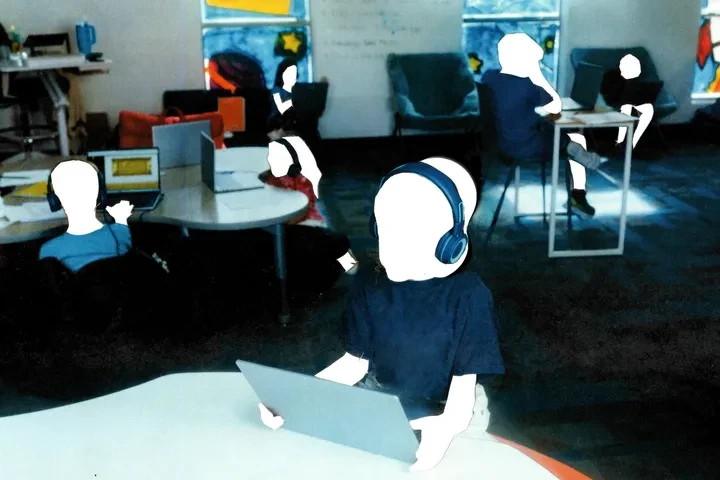
Learning happens in a near-silence: a dozen kids wear headphones, glued to their laptops, only raising a hand when they finish a lesson or run into a tech problem. On-site guides “don't do any teaching,” says Fults, the current head of school. “Usually what it looks like when a guide helps is more like having the student read the question out loud, show where they have done their work, or show what resources they have already accessed and already used.” If a student is truly stuck, they can book a call with an off-site academic coach who is “part of” 2 Hour Learning.
A list of the 31 academic coaches for the 2023-24 school year, obtained by WIRED, shows 26 of the coaches have LinkedIn profiles listing them as analysts for either Trilogy or Crossover, two Liemandt-owned companies. At least 27 of the coaches live outside the U.S., from the Philippines to Colombia, according to their profiles. While some on-site guides have previous K-12 teaching experience, many do not: Frey says when he was CEO, he “often targeted individuals without teaching backgrounds.” Guides told WIRED their colleagues come from coaching, motivational speaking, or entrepreneurial backgrounds as often as education.
At Alpha, guides are only meant to supplement the technology — and the school also uses a suite of surveillance tools, called “basic and extended capabilities,” to flag “incorrect usage” of learning apps. These “anti-patterns” are designed to “help detect engagement and focus issues.” The school can record students’ screen activity, track their mouse and keyboard use, and even use eye-tracking software. Using a “pro sports analogy,” Alpha compares these tools to “game film” for student learning.
While parents are asked to consent to these surveillance programs, the school handbook states there is “no expectation of privacy” on campus. If parents want to restrict recording of their children when they are off-campus doing homework, they have to manually opt out of the “anywhere” recording option — something Jessica Lopez learned halfway through her older daughter’s second year. The girl says she remembers sitting on her bed one night doing homework when she got a notification that she had been flagged for an anti-pattern. The system had sent the school a webcam recording of her in her pajamas, talking to her younger sister.
Neil Selwyn, an education professor at Monash University and author of Should Robots Replace Teachers?: AI and the Future of Education, says efforts to automate teaching almost always underestimate how much teaching requires improvisation and adaptation to an individual student’s unique needs. Alpha’s focus on software-enabled repetition and student self-motivation is typical of education ventures founded by self-taught tech entrepreneurs, he says: they “fix onto self-regulated learning or one-to-one tutoring as the way that one can learn math or science or engineering or coding most effectively. But they didn’t tend to learn history, poetry, or archaeology, or any of the humanities” that way.
Some Alpha Brownsville students say the software can adjust the