
Am I a DEI Hire?
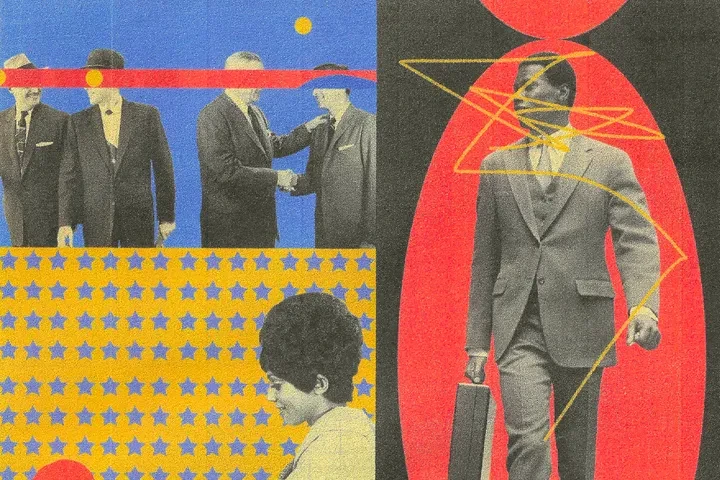
Am I a DEI Hire?
It’s a question I’ve tossed around casually with friends over drinks, friends who share the same tangled, fraught relationship with their careers that I do—maybe you do too. I’ve worked as a writer at WIRED for eight years, and by most measures, I’ve built a successful career here. But eight years is an eternity in modern news media, especially if you’re Black.
Every industry grapples with its own unique growing pains, but news media has a particularly ugly set: laughably high turnover, a deep-seated aversion to racial and gender diversity, and the dubious honor of being perpetually teetering on the edge of collapse. So when my friends and I gather on nights out, swapping stories of workplace microaggressions and corporate mismanagement under dim bar lights, we end up asking the same question: how have any of us lasted this long?
The only reason I’ve survived, I joke, is because I’m Black.
It’s a throwaway joke, of course—one I have no hard evidence to back up, only a persistent, quiet feeling. What I do know for sure is that I’ve been “the only Black person in the room” in more professional spaces than I care to count, and that rarely happened by choice. The higher you climb in journalism, the whiter the field gets. Being the only active Black writer on WIRED’s staff, and one of just a handful in the outlet’s 30-year history, is a failure on the company’s part—and it is—but it’s also standard practice across the entire industry. For a publication that covers the future, often with a critical eye, we too often fail to reflect that future ourselves.
You shape your role, but your role also shapes you. I became the default race voice, squeezed into the race beat, assigned one story after another about the latest Black life cut short by violence. I’ve retraced their final steps in Minneapolis, in Georgia, in New York, in every corner of this country. Editors ask me to make my work “more poetic,” to report on the pain of my community, to find meaning in a tragedy that always adds up to the same grim equation: Black life in America is, at best, conditional. For a very long time—far longer than I’d like to admit—I was okay with this work, because no one else at the publication was going to do it.
Those days were arguably the good ones. Today, being associated with race-based equity work feels like an albatross around your neck in a way it hasn’t for generations. Diversity initiatives are being dismantled across the board, and the federal government, led by MAGA loyalists, has successfully rebranded DEI as a slur—most often aimed at Black people. “That became the problem—and the ignorance,” says Kai Lawson, an executive and former DEI lead at Dentsu Creative. I try not to take this rollback personally, but it’s the end of 2025, and that’s exactly how it feels. Like there’s a target on my back.
But this isn’t just my story. My original plan for this piece was to write an oral history of DEI: tracing its rise, its fall, and what might come next. Would it survive a second Trump presidency and beyond? Would it survive at all? But the more people I spoke to—32 DEI professionals and leaders in total—the more their stories didn’t fit the neat, linear narrative I’d planned. So instead, I’m going to tell you straight: DEI, as we’ve built it, was never going to succeed.
DEI means different things to different people. The phrase “diversity and equity” was coined in the 1980s by Lewis Brown Griggs, a white leadership coach. It was always a rebranding of an older idea—whether you call it preferential hiring or affirmative action, its core goal has stayed roughly the same: level the playing field for advancement. Women, veterans, queer people: many groups have benefited from these efforts. But today, when we talk about DEI in public discourse, the conversation almost always circles back to Black people specifically.
The turning point was 2020. Before that year, Black men held just 3% of management roles in the U.S., and women of color remained one of the least represented groups in senior leadership. DEI efforts were already on a downward trajectory, says Melinda Briana Epler, a strategist and cofounder of the Tech Inclusion Conference, and the COVID-19 pandemic only made things worse. But the murder of George Floyd in May 2020 reignited a national conversation about racial justice that stretched far beyond the usual activist circles. For a moment at least, there was a widespread shared understanding that racism wasn’t just a problem of individual bias—it was a built-in feature of American institutions, and it was long past time for a reckoning.
Floyd’s murder forced corporate America to act. As leaders across tech, entertainment, finance, advertising, and the entire private sector pledged to fix past injustices, there was suddenly “a premium on Black talent,” as Lawson puts it. Before 2020, companies mostly did “random acts of diversity,” says Karen Horne, former senior vice president of North America DEI at Warner Bros. Media. But after 2020, DEI work became formalized within organizations, and practitioners worked to turn those pledges into tangible, meaningful gains. “Before that, we had been treating racism as a theoretical exercise,” says Latasha Gillespie, former global head of DEIA at Amazon Studios and Prime Video.
In 2021, Big Tech joined 83% of U.S. organizations that took formal DEI action that year, promising to increase representation of Black and Latino leaders in senior roles. Companies announced multimillion-dollar investments in social and racial justice organizations. As corporate funding flowed in, a whole new industry of DEI practitioners sprung up—when was the chief diversity officer title ever more sought after, with salaries to match? One estimate from consulting firm McKinsey put the total infusion of capital into racial equity work at $340 billion, spawning what many called the “George Floyd Economy.”
PayPal launched a $500 million fund to support Black and minority-owned businesses. Netflix committed $100 million to financial institutions that serve Black communities. Meta poured $25 million into We the Culture, its first incubator for Black creators. “One thing that Silicon Valley understands is data,” says Ashley Mosley, a former Twitter account executive and co-lead of Blackbirds, Twitter’s Black employee resource group. “And once they started to see the business case for it, for some people it clicked.”
President Biden signed two executive orders aimed at boosting diversity efforts across the federal government, opening the door for private companies to follow suit. As workplace culture shifted, many Black employees felt newly empowered in their roles—I know I did. Those days were heavy, but they were also heady. I published some of my biggest career stories during that period; one was even adapted into a Hulu documentary. For a while, it felt like things might actually change for the better. “It was the peak of the bell curve,” says Karen Driscoll, a consultant at Raben.
Lybra Clemons was Twilio’s chief diversity, inclusion, and belonging officer back in 2020. By September of that year, the company publicly committed to becoming “anti-racist,” a philosophy that had gained widespread traction after the 2019 publication of Ibram X. Kendi’s How to Be an Anti-Racist. “This was a company that built its brand on being open and progressive,” she says. “Our CEO was committed to that vision, and so were many other CEOs at the time. Looking back, I don’t think any of us understood just how impossible the work actually was.”
Vernā Myers has worked as a diversity consultant for more than 30 years. In 2018, she became Netflix’s first vice president of inclusion strategy. She has long seen DEI as “the scaffolding that made it more possible” for middle-class people of color to overcome the systemic economic disadvantages they’ve inherited. But even in the early days of the 2020 reckoning, as anti-Black racism became a national talking point and long-silenced conversations about biased hiring, pay equity, and fair organizational structures suddenly went mainstream, she had misgivings. “You’ve got this horribly devastating event, and you’re thinking, ‘Is this what it took?’” Myers says.
It quickly became clear that corporate America had little interest in real, lasting change. “What practices let you hire 20% more Black people that quickly if you weren’t doing that before? It was performative positive discrimination,” says Darren Martin Jr., CEO of diversity consultancy Bold Culture. Many insiders knew from the start that these gains weren’t a genuine fix for a broken system: DEI was framed as a cultural problem, but in reality, it’s always been an economic issue. At its core, it’s about class—about America deciding who gets access to wealth and opportunity, and how much they get. “There was this expectation that you, a 75-year-old company, could hire one person and they would fix all your cultural problems in two years,” says Jarvis Sam, a consultant and former chief DEI officer at Nike.
More than anything, the work took a devastating mental toll. “It was exhausting,” Myers says, and I know that feeling all too well. I remember an assignment where I had to watch, rewatch, and unpack the footage of Ahmaud Arbery’s murder, trying to stitch together meaning from senseless violence. The work felt urgent and important—but as Myers puts it, “it comes at a cost.” There’s a moment from that era that still haunts her. “A colleague said to me, ‘It’s like they’re nursing at our tits again.’ Every leader was calling me, asking ‘What do I say? What do I say?’ Little by little, we give away our energy and our knowledge just to nurture them along.”
Lawson puts it another way: “My job was not to cure racism.” Not long after Floyd was killed, the company she worked for asked her to draft recommendations to better support Black employees. “We came up with the real solutions—better pay, faster promotions. I brought it to the head of HR and they said, ‘None of this will get us a headline. I need something that will get us a headline.’ That’s when she realized what DEI was actually for in corporate spaces. “The corporate function of DEI is not to actually make things better—it is to pacify.”
What many quickly learned was that corporate activism (if it even exists) has a hard ceiling. It was a reaction to pressure, not a permanent change in behavior. “It was a microwave approach—fast, shallow, and unsustainable,” Martin says. Judy Jackson, former global head of culture at WPP, remembers when the tide started to turn. Employees grew tired of the conversation, and leaders grew bored of it. DEI fatigue spread fast. “It was, ‘Can we talk about something else?’” Jackson says. DEI “can sort of encourage a sense of us versus them, which is not its intent. People would say things like, ‘Well, I want to start a white ERG [employee resource group].’”
By the end of 2022, DEI went from boom to bust, and a “blatant regression” set in. “Someone on LinkedIn told me we were contributing to America’s race problem,” Sam says. As soon as the economy cooled, DEI budgets were the first to get cut, and dozens of companies eliminated DEI-linked roles entirely. When I asked a DEI executive what stood out about that period, and if the whole project was always just corporate theater, she didn’t mince words. “This is corporate America—what are you expecting?” she says. “It was always going to be only this good.”
On a cold January morning at Washington, DC’s Capital One Arena, the future battle lines came into clear focus. After a rally where President Trump revoked 78 executive orders and memos from the previous administration, he signed a new order ending “radical and wasteful” preferential hiring in federal agencies. He followed that with a second order targeting DEI programs across the private sector, appointing allies at the Justice Department and Federal Communications Commission to launch investigations into companies that maintain DEI standards.
Trump has taken a uniquely hostile stance on diversity issues. His administration has removed Black historical figures from federal government websites, scrutinized the National Museum of African American History and Culture, and pushed for layoffs in the federal workforce—a sector where Black workers have long been overrepresented. All of this is being carried out by a federal government that openly challenges the basic legitimacy of Black life in America. “Why would we expect the Ku Klux Klan not to burn a cross?” says a former engineer who worked at both Twitter and Google. “That’s what they do. Trump is a racist, and he’s pandering to racist people.” This summer, Bureau of Labor Statistics data shows Black unemployment surged to its highest level since 2021.
In America, you can never outrun the central role of race in our society. Right now, as you read this, that same inescapable reality—built on centuries of power imbalances and racial hierarchy—is pushing entire industries to the brink.
This isn’t exactly a new revelation. Black people have faced systemic, often insurmountable barriers throughout U.S. history: no other group has been as exploited, as brutally enslaved, or as continuously disenfranchised. We’ve made progress in spite of those barriers, but empowerment always comes at a steep cost. There’s an unwritten fine print that reminds us: you’re only allowed to go so far, achieve so much. In theory, that’s what made DEI so dangerous to people who want to preserve the status quo. It had the potential to lift up not just a handful of people, but the fortunes of many—and could have been a real, if incremental, start to restructuring America’s unfair class dynamic. “Some of us got great big jobs with these great big bonuses and bought great big homes and built great big lifestyles,” Lawson says. But when you’re Black and successful, when you reach for more than the world told you you’re allowed to have, it’s only a matter of time before the history of hate and antagonism shows its true face. “Every time there’s been an advance, a call for a reckoning, a sense in which more fundamental transformative possibilities are on the table, there has come after that a backlash,” says legal scholar Kimberlé Crenshaw. “The crux of anti-Black racism is the idea of our deficit.”
In the summer of 2023, the Supreme Court effectively ended affirmative action in college admissions, ruling that race could not be a primary factor in admissions decisions. “It was America being America,” tech engineer Leslie Miley says of the ruling. “Stevie Wonder could’ve seen that coming.” The ruling gave new momentum to opponents of DEI, spurring a wave of new legal attacks. That July, 13 Republican state attorneys general notified the 100 largest U.S. companies that the court’s ruling should also apply to private employers.
The following month, anti-affirmative action activist Edward Blum—who organized the college admissions cases—put that theory to the test when a group he leads sued the Fearless Fund, an Atlanta-based venture capital fund that invests in women of color entrepreneurs. Though the parties settled, Blum effectively won. The case was “a big tipping point,” Epler says, because it exploited anti-discrimination laws that were originally written to help, not harm, Black women. By the end of 2023, several major corporations including Meta, Tesla, DoorDash, and Lyft had cut the size of their DEI teams by 50% or more.
People panicked. A Black tech worker in San Francisco, who asked to remain unnamed, took drastic steps to protect their career. “I knew what was coming,” they told me. “Anything that had to do with DEI, the election, or voting, I deleted it. I deleted a bunch of old tweets. I redid my LinkedIn bio, unlisted my Medium articles, removed old job posts. I don’t want to be labeled a DEI hire or connected to people who talk about this work. We’re in the first year of the new administration, and we have a long road ahead. Put your own oxygen mask on first. Take care of yourself.”
By the time I finished reporting this story, no fewer than three people who had originally agreed to speak on the record asked to be anonymized. “The climate isn’t the same today as it was in March,” one tech executive told me. “I wouldn’t say those things now because of the pattern of retribution.”
Many expect things to get even worse, and for people I love—family, friends—it already has. “I don’t even think we’ve hit the tip of the iceberg yet,” Mosley says. “A lot of really terrible things are going to happen as people try to reset this country. People have every right to feel panicked.” This spring, more than 300,000 Black women were reported to have been pushed out of the U.S. workforce, and a November federal jobs report puts Black unemployment at nearly double the overall national rate. When I said it’s hard not to take this personally, I meant it. I’ve clung to the idea that my status as the only Black writer on staff makes me safe, but that might not matter anymore: the Black middle class is being erased.
But maybe DEI was always destined to fail.
Almost every person I spoke to agreed that DEI never had clearly defined, shared goals. There was no unified plan or set of priorities for DEI practitioners, either within individual companies or across the industry. “There were some gaps in the collective narrative,” says Rachel Williams, former head of DEI at Google X. Or as Jackson puts it, “No one had the playbook.” The fact that grifters were often appointed as public figureheads for DEI only hurt the cause more.
Beyond that, no matter how many diverse hires you make or how many diversity benchmarks you hit, real change only happens if a company actually wants to change. McKinsey’s research never claimed that simply placing a person of color in a role would automatically boost a company’s bottom line. “The minute you try to turn a capitalistic organization into a social justice organization, that’s when you are going to fail,” Gillespie says.
Driscoll adds another point: “The fact that we use the acronym is also problematic and was to our detriment,” because it automatically makes people think of “quotas over qualifications.” Indeed, the entire post-2020 DEI boom ended up amounting to little more than a mild reshuffling of the existing Black professional class.
At the same time, “governments don’t backlash against things that aren’t working,” Sam says. “They just let it die on the vine. What that implies is that we did make real progress.” I keep coming back to Myers’ point that DEI was a scaffolding that