
The Search for the Ideal Buttock: A Plastic Surgery Lineage in Mexico City
The Search for the Ideal Buttock: A Plastic Surgery Lineage in Mexico City
When you trace the full history of gluteal enhancement, one city rises above the rest—literally. Mexico City has always stood out, and not just geographically. It was here in 1979 that plastic surgeon Mario González-Ulloa inserted the first set of silicone implants purpose-built for the human buttocks. The surgical textbook Body Sculpting with Silicone Implants even anoints González-Ulloa the “grandfather of buttock augmentation.”
By the early 2000s, a new generation of Mexico City-based gluteal transformation pioneers emerged, led most notably by Ramón Cuenca-Guerra. In his 2004 landmark paper “What Makes Buttocks Beautiful?”, Cuenca-Guerra outlined four core traits that “define attractive buttocks,” plus five categories of “defects” each with its own targeted correction strategy. For the record, I fall into defect category 5: the “senile buttock.” (González-Ulloa once illustrated this contrast with charcoal nude sketches, pitting the archetypal “happy buttock”—high, rounded, dimpled—against its opposite: the droopy, low-slung “sad buttock.”)
While I appreciate the value of standardizing surgical protocols and laying clear practice guidelines, Cuenca-Guerra’s research methodology gave me real pause. Who exactly decided what counts as ideal, and on what basis? Here’s how the study worked: 1,320 photos of nude women aged 20 to 35, all shot from behind, were shown to a panel of six plastic surgeons, who “identified which buttocks they found attractive and harmonious, and the features this attractiveness depended on.” Oho, I thought. That’s hardly a diverse, representative sample of public opinion.
I thought it would be fascinating to chat with Cuenca-Guerra about the idea of a visually perfect female rear end—one that can (or should) be created surgically, or recreated in the case of a “senile buttock,” and even whether such an ideal exists at all. I tracked down the email address listed on one of his more recent journal papers and sent a note, but never got a reply. It turns out Ramón Cuenca-Guerra doesn’t need buttock augmentation anymore; he’s been dead for years. Instead, I connected with his former trainee, José Luis Daza-Flores, third in this unbroken surgical lineage: just as Cuenca-Guerra studied under González-Ulloa, Daza-Flores learned the craft from Cuenca-Guerra, making him, I suppose, the “son of buttock augmentation.”
Daza-Flores co-authored a paper with Cuenca-Guerra called “Calf Implants,” where the team did for the lower leg exactly what Cuenca-Guerra had done for the buttocks: they laid out “the anatomical features that make calves attractive” and cataloged the “defects” that can be corrected surgically. Once again, practicing plastic surgeons were recruited to judge thousands of images—2,600 to be exact, a veritable centipede of photographic female legs.
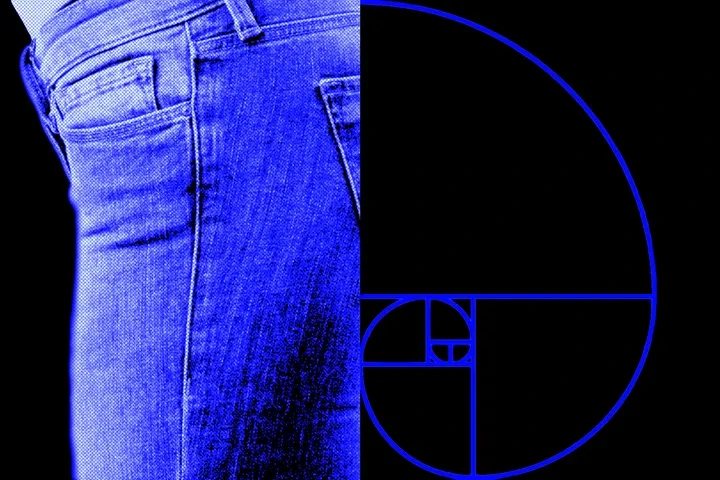
The paper took a surprising turn. The authors argued that the measurements of an attractive lower leg align with mathematics’ famous divine proportion (also called the golden ratio), roughly 1.6 to 1 when rounded. For the uninitiated: if you split a line into two segments such that the ratio of the full line to the longer segment equals the ratio of the longer segment to the shorter, that ratio is 1.6 to 1. (I checked an illustration on the math education site Math Is Fun, and I’m still not 100% convinced, but that’s the rule.) The golden split divides the line into roughly two-thirds and one-third, a proportion the ancient Greeks used to map the “ideal” human face. This was the first time I’d ever seen the divine proportion applied to a human calf.
The paper included lines like this: “Seventeen women had thin legs, in the shape of a tube, and a mere 1:1.618 ratio in the A-P and L-L projections.” While I’ll admit I don’t follow all the technical jargon, I’m pretty sure that’s just a mathematically fancy way to describe cankles.
The paper also cites the Fibonacci sequence, a number progression where every term after the second 1 is the sum of the two preceding terms: 1, 1, 2, 3, 5, 8, 13, 21, 34, 55 . . . If you take two consecutive terms starting from 3 and 5—say 21 divided by 13, or 13 divided by 8—and you divide rather than add, you always get, ta-da, the divine proportion of 1.6.
The Fibonacci sequence pops up constantly in nature: it shapes the spiral of a growing nautilus shell, the arrangement of seeds in a sunflower head—those are the two most common examples. (Less commonly cited: the branching pattern of the sneezewort plant.) In human biology, it’s supposedly everywhere, not just in calves. Number-obsessed doctors and researchers have published papers claiming the golden ratio appears in everything from the relative lengths of finger bones, the proportion of incisors to canine teeth, the structure of aortic valves and coronary artery branching, the size of the uterus at peak fertility, the “optimal nipple position,” even the spiral structure of DNA.
It’s a fascinating idea, even if it’s not entirely proven: that beauty is ultimately defined by mathematics.
When I asked Daza-Flores about this framework, he confirmed that whenever he performs fat transfer to the hips and buttocks, he follows the Fibonacci sequence. I immediately pictured him standing over an anesthetized patient with a purple surgical marker and a ruler, sketching arcs and equations across their torso. I also wanted to ask how he navigates what his field calls “the Kardashian movement”: the skyrocketing demand for rear ends that fall far outside the traditional Fibonacci ideal.
José Luis Daza-Flores’ plastic surgery clinic sits on a quiet residential side street in Noche Buena, a pleasant Mexico City neighborhood. The building also houses a day spa and a cosmetic dentistry practice, but its unassuming exterior gives no hint of the high-end cosmetic work that goes on inside. The waiting room is designed to calm rather than impress: seating is plush, the space is quiet, the weekday chaos of Mexico City replaced by soft synthesized instrumentals and the occasional quiet spritz from a wall-mounted scent diffuser.
This lack of fanfare matches Daza-Flores’ personal demeanor. He’s courteous, soft-spoken, unfailingly polite. He’s the kind of man who says “por favor” to Alexa when he wants to change the music in the operating room. I’ve watched him greet patients in the waiting room and before surgery, reaching out to take their hand to put them at ease.
It’s 8:15 a.m. on the day of my visit. Daza-Flores sits in the clinic’s small kitchenette, dressed in scrubs, sipping an espresso while his morning patient is prepped for surgery down the hall. He looks younger than his age, but you can tell he hasn’t had work done himself. I don’t spot any of the “defects” his line of work is so fond of identifying.
I pull Cuenca-Guerra’s “What Makes Buttocks Beautiful?” paper out of my folder and slide it across the table.
As respectfully as possible, Daza-Flores distances himself from the earlier work. Cuenca-Guerra focused almost entirely on the placement and size of buttock implants, he explains, but he completely overlooked the side of the hips. It’s that lateral hip projection, paired with a narrower waist, that creates the classic hourglass silhouette. You can make your buttocks stick out all the way to Puerto Vallarta, he says, but that won’t change how the patient’s whole figure looks from the front. It won’t turn a grandfather clock silhouette into an hourglass.
Way back in 1973, a few years before Dow Corning partnered with González-Ulloa to create the first cosmetic buttock implants, Tennessee surgeon William Cocke inserted a pair of silicone implants under the skin of the flanks of a woman who was “very concerned about her underdeveloped hips.” Textbooks describe the results as “less than optimal.” That’s probably because implants placed just under the skin and fat, rather than beneath or between muscles, tend to shift over time, and their edges often show through the skin. (Cocke’s writeup of the procedure never mentions any of these issues, simply noting that “the patient has since married.” As if narrow hips had been the only thing standing between her and wedded bliss.)
“To reshape this lateral contour, you need fat,” Daza-Flores says. He stands up and pulls a bowl out of the refrigerator, and for a split second I think he’s about to show me a bowl of harvested human fat. It’s just papaya, of course. He sets it on the table between us. “Fat transfer,” he continues. That’s the process of suctioning fat from one part of the body and injecting it into another. The general technique is called liposculpture; when it’s used on the rear (with or without implants), it’s commonly known as a Brazilian butt lift.
“So the surgical techniques have changed,” he says, “but the concept of divine proportions has stayed the same.”
I ask Daza-Flores to show me examples of his patients who match the golden ratio ideal. He scrolls through photos on his laptop, and most of the patients are TikTok stars and beauty influencers. “These are pretty close to ideal proportions,” he says. But here’s the catch: their before photos already looked pretty ideal to me. Back in 2021, a team of Norwegian and American plastic surgeons published a paper focused on golden proportions in breast aesthetics. One statistic stuck out to me: out of 37 study participants, only five had breasts that fit the golden ratio. Four more had just one breast that fit. “Neither breast was considered optimal for 28 (76 percent of) subjects.” The highest aesthetic score went to a “virtual subject”—a computer-generated torso. Plastic surgeons and their patients are chasing an ideal that almost never exists in unaltered human anatomy. The more cosmetic work beauty influencers get, whether surgical or via TikTok filters, the worse the rest of us feel about our completely normal bodies and faces.
And there’s another shift: these days, the popular desired look has even outgrown Fibonacci’s ideals, drifting into the realm of cartoon and anime proportions.
Before I visited, I printed out a set of photos from the London tabloid The Sun, purporting to show Kim Kardashian from behind in a thong bikini. Her buttocks and hips are so large they dwarf the rest of her legs, a “defect” a paper in Aesthetic Surgery Journal calls the “lollipop deformity,” or “marshmallow on a stick.”
“That’s not beautiful to me,” Daza-Flores admits. He uses his fork to point to the crease at the base of her buttocks. “It’s too long, and too folded.” Professionally called the intragluteal fold, it should be a gentle indentation that extends no more than a third of the width of the buttock, he says. The folds on the Kardashian photo stretch all the way across each cheek. “It looks like an overly heavy buttock.”
A woman with double-D breast implants is carrying around four extra pounds of weight on her chest. When women complain of sagging breasts, Daza-Flores almost always recommends a lift rather than larger implants. “If you use an implant, it will look good for about six months, but eventually it will sag worse than it did before.”
Daza-Flores slides the printout back across the table to me. “She has every procedure you can get, all at once. Implants, fat transfer, Sculptra injections,” he says, referencing the popular dermal filler. “She’s probably getting something new every six months. And girls ask for that. They say, ‘I want the Kardashian surgery.’”
So who wins? Fibonacci, or Kardashian?
“I try to tell patients not to go that far,” Daza-Flores says. He tries to get to the root of why they want the procedure: is this something their partner wants? He advises against getting cosmetic surgery to please someone else, because as he puts it, the surgery usually outlasts the relationship. He’s had patients who “replace their breast implants every time they change boyfriends.”
He also reminds patients that this look is just a trend, and like all trends, it will fade. (Sure enough, two years later when I was updating this chapter before publication, the American Society of Plastic Surgeons was reporting a new Ozempic-fueled trend toward a leaner “ballet body.”)
Daza-Flores finishes his espresso. “If I don’t do it, they’ll just get it done anyway. They’ll go to another doctor.” Often, that doctor isn’t a board-certified plastic surgeon. It might be an aesthetician or a general practitioner who got a certificate from an online course. Daza-Flores calls these providers “nomads,” because once malpractice lawsuits start piling up, they just move to another city or state. One good way to vet a provider, he says, is to check how long they’ve been practicing in the same location.
Daza-Flores won’t be using any buttock implants on his morning patient—only fat transfer. He’s been using implants less and less lately. The Brazilian factory that makes his preferred brand burned down, and other companies have had trouble getting or renewing their import licenses. Daza-Flores suspects corruption is behind the delays: government officials demanding exorbitant fees and bribes.
But the real reason is that José Luis Daza-Flores loves working with fat.
I’ve always been fascinated by medical equipment catalogs. The people who name the tools and write the product copy never seem to consider that anyone other than a doctor will ever read it. Would you really name a liposuction cannula The Fat Disruptor otherwise? Or the Bayonet Infiltrator? The small tool that clears a path for the cannula is called a “punch,” which per the Black & Black Surgical catalog description “makes the initial stab wound.” That step is done, and the cannula is inserted, working its way through the patient’s lower back. The back-and-forth motion of liposuction looks a lot like using a handheld vacuum cleaner, just faster and more vigorous—more like mopping than vacuuming, actually.
Daza-Flores waits for me to finish rambling about the silly tool names. “It feels like grating cheese,” he says.
Around 20 percent of what gets suctioned out is blood, so the mixture moving through the tubing is dark pink rather than pale yellow. Combined with the fact that the fat collection canister looks just like a blender jar, it looks like Daza-Flores is pulling a raspberry smoothie out of his patient. His wife, who’s also a doctor, worried I might faint or feel sick at the sight of fat being suctioned from a body. If anything, it just made me hungry.
Once the canister starts filling up with the “raspberry treat,” blood cells and serum separate out, leaving a layer of clean fat on top. Daza-Flores uses the word decant to describe this step, which adds a nice touch of elegance to the whole messy process. Some surgeons use a centrifuge to separate the fat, but Daza-Flores believes the forceful spinning damages or kills too many fat cells. Even with his gentler method, about half of the injected fat cells will die and be reabsorbed by the body.
The fat Daza-Flores loves the most is the fat most of us hate: love handles, the stubborn blubber right along the waistband. “This is fantastic fat,” he tells me. He loves it for the exact reason we hate it: it’s notoriously stubborn. When someone diets, this is usually the last fat to go. When they start gaining weight again, this is the first place it shows up. In liposculpture, Daza-Flores moves these stubborn back fat cells from where they’re unwanted to where they’re wanted. “The genetic information stays with the cells,” he says. Now if the patient gains weight, it won’t show up as back fat—it will show up as curvy hips and a perky, “happy” buttock. It’s called donor dominance, and it’s genius.
For that same reason, Daza-Flores never uses back fat to add volume to the face. “If you take fat from down here, and then the patient gains weight, their cheeks get fat.”
We’re almost done. The punch made small entry wounds, which the cannula has widened into little slots, like the patient has USB ports on her body. An assistant swaps out the cannulas, switching from the suction tip to an injection tip. All in all, about six quarts of fat have been suctioned from the patient, two quarts of which will now be injected into her buttocks and lateral hips. This is where Fibonacci comes in. Daza-Flores starts at the outer flank, spirals down and around, and finishes at the center of the buttock. He compares the path he follows to the spiral of a snail shell, another natural example of Fibonacci numbers. I’d pictured him working from exact calculations, plotting points on the patient’s skin before starting. But after decades of practice, he says, he can do it by eye now.
The injection cannula has a plunger, which Daza-Flores squeezes as he pulls the tool backward. If you could see under the skin, it would look like someone decorating a cake—with human fat. Happy birthday! He pauses at the top of the patient’s left buttock.
“Mira. This is a dangerous area.” Underneath the gluteal muscles are several large blood vessels. Even a small amount of fat that gets into the circulatory system can cause a catastrophic “uniformly fatal fat embolism.” I’m quoting that from a 2018 press release from the Australasian Society of Aesthetic Plastic Surgeons that named the Brazilian butt lift the most dangerous cosmetic procedure. An embolism is a clot that breaks free and gets stuck in a narrow blood vessel, blocking blood flow. If it lodges in the heart, brain, or lungs, it’s deadly.
“There were a lot of deaths,” Daza-Flores says. “A lot of young women dying from fat transfer. We didn’t understand what was going wrong.” Daza-Flores was part of a task force that reviewed autopsy reports, and they found fat in the muscle in every single case. Instead of keeping the injection cannula roughly parallel to the muscle, some providers inject directly down into it. Even if the angle is off by just 1