
He Built an Entire AI-Generated Sci-Fi Universe No One Thought Possible. Meet the First Auteur of the AI Age
He Built an Entire AI-Generated Sci-Fi Universe No One Thought Possible. Meet the First Auteur of the AI Age
The alien named Tiggy just wouldn’t take direction. All the filmmaker needed was for the glistening brown creature to turn its head on cue. Seated in the passenger seat of a police cruiser, Tiggy defied every attempt to get it right. First, it barely shifted its gaze. Next, it turned toward the wrong side of the camera. Then its smooth skin broke into blotchy, uneven patches, like an overripe peach gone wrong.
The filmmaker wasn’t on a Hollywood soundstage, and he wasn’t filming on Mars. He was sitting at his home computer in Los Angeles, cycling through AI image generation to get a usable shot of the creature. He’d used Midjourney to build Tiggy’s original design (prompt: “fat blob alien with a tiny mouth and tiny lips”), ElevenLabs to tweak the alien’s voice timbre (layering his own voice over a synthetic track and cranking the pitch way up), and Runway to map the exact shot framing he wanted for the scene (“close up on the little alien as they ride in the passenger seat, shallow depth of field”).
AI gets a lot wrong, after all. One iteration of Tiggy came out inexplicably muscular. Another had a weirdly dry back. When the filmmaker asked one tool to give the back of Tiggy’s head “frog-like skin,” it pasted an entire frog face onto his neck. The tools also kept fighting him on Tiggy’s canonical lack of clothing: when he typed “short shirtless alien,” he got an error, triggered by the platform’s content safeguards. “I guess it was just the word ‘shirtless,’” he guessed.
Public conversations about generative AI almost always fall into two extreme camps: it’s either going to end human creativity as we know it, or it’s all overhyped nonsense. But watching this creator work—morning iced coffee in hand, messy brown hair and a slightly unkempt beard—tells a far quirkier, less dramatic story. It’s like sitting in on a puppy training class: the tools ignore commands, make baffling choices, and veer wildly off track. But with patience and care, he pulls them back in, slowly coaxing an eight-minute, tightly scripted original TV episode out of the code.
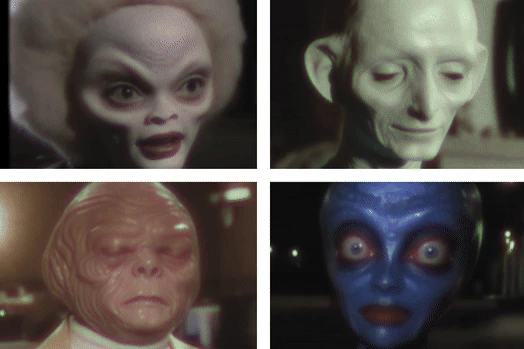
That eight-minute episode is the latest entry in the sprawling sci-fi universe Josh Wallace Kerrigan has built under the brand name Neural Viz. The project launched in 2024 with Unanswered Oddities, a mockumentary web series set in a far future where Earth is populated by blob-like creatures called glurons, who host a talking-head show debating the existence of humanity in the vein of Ancient Aliens. Each episode digs into a different (and consistently mispronounced) element of “hooman” life: America, working out, the NFL. What started as a one-off silly bit quickly grew.
The shared world, called the Monoverse, soon expanded far beyond the first series. Neural Viz churned out new shows from the in-universe gluron TV network Monovision: a documentary-style cop procedural, a UFC-style combat show for fighting bugs, then podcasts and on-the-street interviews. Subplots and overarching story arcs emerged between videos: romances bloomed, secret religious cults lurked in the background, and grainy archival footage leaked out revealing the true story of humanity’s extinction. Before long, Kerrigan had built an entire fully realized world with its own language, cast of characters, and deep lore—all built with generative AI.
Neural Viz first became a cult favorite among Reddit users and AI enthusiasts on X (formerly Twitter), before breaking into the mainstream: individual videos now rack up hundreds of thousands of views on YouTube and millions more on TikTok and Instagram.
Beyond its popularity, Neural Viz is already a landmark: it’s one of the first examples of AI filmmaking that doesn’t suck. Ask anyone what “AI video” brings to mind, and you’ll get a litany of memeable mess: hippos falling off diving boards, babies flying planes, Will Smith shoveling spaghetti, world leaders locking lips. In short: digital slop. The medium has a bad reputation for good reason, both aesthetic and political: critics argue AI will destroy Hollywood jobs, turn the entire industry into algorithm-fed mush, and erase human creativity entirely.
Neural Viz charts a completely different path. In a sea of low-effort, lowest-common-denominator AI dreck, its creator is building original, specific work as lovingly crafted as any mainstream series out there. Two key details set it apart: even as he uses AI for almost every on-set role, Kerrigan writes all his scripts the old-fashioned way. He also voices every character himself, using AI as a creative mask rather than a replacement for his performance. Once all his shots are mapped out, he uses Runway’s facial motion capture tool to bring Tiggy and other characters to life by acting out their lines—like Andy Serkis playing Gollum, without ever leaving his swivel office chair.
Just as Trey Parker and Matt Stone reinvented animation by leaning into cheap, accessible tools, the creator behind Neural Viz is taking a technology many dismiss as inferior and using it to push filmmaking in a new direction. He just might be the first AI auteur—and he maintained total anonymity until now.
The youngest of three brothers, Kerrigan grew up in a small town outside Wichita Falls, Texas, falling in love with blockbusters like Tremors and Jurassic Park as a kid. When he was 9 or 10, he and a friend used his desktop computer’s built-in webcam to make a short film about a serial killer who targeted baseball players. Its tagline: “Three strikes, you’re out.” He studied film at Minnesota State University Moorhead, and moved to Los Angeles after graduating in 2012.
For the next decade, he followed the familiar path of an aspiring comedy writer in 2010s LA. He worked a string of day jobs: barista at a Starbucks located inside a Target, assistant to the co-writer of the frat comedy Neighbors, producer of behind-the-scenes and promotional content for films like Mufasa: The Lion King and the John Cena-Akwafina comedy Jackpot!. He co-founded a sketch group called Hush Money, released a new video every week for a year that ran on Funny or Die’s YouTube channel, and earned a shoutout from James Wan for their Saw parody. In 2021, he directed a low-budget horror feature and sold a TV pilot to Disney.
Kerrigan built up a full skill set, able to step into any role on a set from cinematographer to gaffer to sound engineer, but he never broke through to lasting, stable success. The pandemic and its aftermath gutted the traditional Hollywood career path for emerging writers. The streaming bubble burst, writers’ rooms shrank, and the 2023 writers’ and actors’ strikes froze production for months, with the final contracts reflecting a shrinking pie and widespread fear of AI’s encroachment on labor.
In 2023, Kerrigan started experimenting with 3D modeling tools like Blender and Unreal Engine. He’d long been interested in animation, drawn to the idea of building characters and sets he could return to anytime, and wanted to see what he could create entirely on his own. He soon discovered new generative AI tools that automated and sped up the most time-consuming, difficult parts of 3D modeling.
When most people try generative AI for the first time, they jump straight to the zaniest idea they can think of—though these “wild” ideas are often surprisingly generic: dragons in space, crying kittens, robot uprisings. Kerrigan took the opposite approach: he studied AI’s limitations and worked around them. He noticed AI struggled with action sequences but excelled at static talking-head shots, so he decided to build a documentary-style project. To avoid the uncanny valley effect of simulated human characters, he opted for soft, bulbous alien creatures. To hide minor rendering flaws, he leaned into the grainy, retro look of 1980s and 1990s cable TV. Thus Unanswered Oddities was born, a deadpan homage to Unsolved Mysteries that’s immediately recognizable to anyone who’s stayed up late watching true crime cable.
Kerrigan’s early episodes were a little rough around the edges, but they quickly established the project’s off-kilter comedic voice and ambitious worldbuilding. They also set up the Monoverse’s core conflicts: the autocratic, godlike Monolith that rules the gluron homeworld, a Resistance movement fighting to overthrow it, and fast-talking conspiracy theorist Tiggy Skibbles, who claims “hoomans” never existed—then mysteriously disappears.
For Kerrigan, discovering generative AI felt like unlocking a superpower. “The first time you start to see those weird creatures talking and whatnot, it is pretty mind-blowing,” he says. He compares the feeling to that viral meme of the guy standing in the corner of a party watching everyone dance, thinking to himself, They don’t know.
Reddit users were immediately impressed by Neural Viz’s choice to lean into AI’s idiosyncrasies, even its flaws, rather than trying to hide them. Other creators also praised the work, and spent months speculating about the anonymous creator’s identity. “I thought he was Mike Judge hiding under a pseudonym,” says Zack London, who creates AI videos under the name Gossip Goblin and has more than a million Instagram followers.
Encouraged by the positive early response, Kerrigan decided to keep making more episodes, but he had no overarching roadmap. “There was no plan,” he says, which is part of why he chose to stay anonymous. He experimented with new formats, driven by his love of genre satire and a desire to keep the work interesting for himself. He created The Cop Files, an X-Files/Cops spinoff where a detective investigates Tiggy’s disappearance, followed by Human Hunters, a parody of Ghost Hunters.
The series evolved right alongside AI technology itself. New generative AI tools launch constantly, and Kerrigan made a point of testing as many as he could (early adoption of new tools tends to draw tech-curious viewers). When he started, he would record dialogue lines into his microphone, and AI would roughly align character mouth flaps to the audio, adding basic facial movement. This gave him some control over performances, but not much. Then in October 2024, Runway released its Act-One motion capture tool. Suddenly, he could act out lines in front of his computer’s webcam, and the software would map both his voice inflections and facial movements directly onto the 3D character model. This gave him far more control over how characters looked and behaved, and made the work feel more personal than ever. (Kerrigan says he’d eventually like to hire other actors to diversify performances, but for now it’s simpler to voice every role himself.)
Sometimes new tools opened up entirely new storytelling possibilities. When Google’s Veo 2 video generator launched, Kerrigan created a flashback sequence showing the moment the Monolith wiped out humanity—the series’ first fully scripted large-scale narrative sequence. The Cop Files shifted to become more narrative as a result: instead of just talking directly to the camera, characters now moved around, interacted with each other, and went on full quests.
Even AI’s mistakes often became creative fodder. In an April 2025 episode, Tiggy’s skin was noticeably smoother than usual, because the Sora video generator Kerrigan was using struggled with consistent character texture. To cover the flaw, Kerrigan wrote a line where Tiggy explains he’s “metamorphosizing” because he can no longer afford his “morph inhibitors.” This plot point fit perfectly with the fan theory (held by some in-universe characters) that glurons are mutated descendants of humans, and “morph inhibitors” has since become a running gag across the series.
Another character, a knife-obsessed gluron rancher named Reester Pruckett (many Neural Viz characters are reimagined versions of the Southern men Kerrigan grew up around around Texas), has a strange tic of drawing out the first vowel of every sentence for an absurdly long time, e.g. “Iiiiiiiiiiiiiiiii came out here to practice my switchblade.” The quirk started as an audio glitch in one of Kerrigan’s early tools, but it was so funny he kept it as Pruckett’s signature.
By late 2024, Hollywood executives were sliding into Kerrigan’s social media DMs. He says he’s spoken with “almost all of the major studios,” as well as producers and creators interested in collaborating. Many YouTube commenters have told Kerrigan his work belongs on Adult Swim, and when he met with Adult Swim-affiliated producers, one told him he might not need the network at all: power has shifted to independent creators now. “That sentiment has come up multiple times in meetings with other various studios,” Kerrigan says.
The meetings led to two formal job offers. One was an in-house role at a major studio leading AI projects. Kerrigan turned it down to develop his own original TV pilot (unrelated to the Monoverse) with an independent producer. He also has a non-AI short film he co-directed set to premiere at SXSW in spring 2025. Between the pilot contract and ad revenue from Neural Viz’s social media channels, Kerrigan now makes enough to cover his living expenses. So in January 2025, he quit his day job for the first time since moving to LA.
In June 2025, I attended the AI Film Festival in New York City, an event organized by AI software company Runway. Hundreds of attendees packed Lincoln Center’s Alice Tully Hall to watch the 10 best AI short films of 2025, selected from 6,000 submissions.
I left the event feeling deeply underwhelmed. Most of the films were visually stunning but conceptually and narratively empty. The event, which included a platitude-heavy Q&A with musician Flying Lotus and a partially AI-generated music video for J Balvin, felt tailor-made to confirm critics’ worst fears that AI art is all surface and no substance. (The only exception, a clever, unsettling film essay called Total Pixel Space, took home the top prize.)
It’s a strange paradox of AI filmmaking that even as the tools get faster and more sophisticated, very few creators are producing memorable, original work. There are a handful of standouts beyond Neural Viz: London’s Gossip Goblin makes ominous, impressionistic videos about a future overrun by AI; musician Aze Alter makes eerie horror-themed shorts; comedy duo TalkBoys Studio (friends of Kerrigan) make animated shorts with talking animals and dinosaurs.
Far more common are lazy prompt-and-play AI videos built solely to go viral. When Google’s Veo 3 launched in May 2025, making multimodal video generation as simple as typing a text prompt, social media feeds flooded with (for reasons only the algorithm understands) vlogs of Bigfoot talking into a front-facing camera. One influencer even bragged about setting up an automated LLM-to-video pipeline that generated and posted a new Bigfoot clip to TikTok every hour. OpenAI’s September 2025 release of Sora 2, which lets users scan their own faces and insert themselves into any video, has only accelerated the flood of low-effort slop.
Part of the reason Neural Viz has cut through the noise is that Kerrigan relies on traditional filmmaking craft for almost every step of the process. He always starts with writing: full scripts with slug lines, action descriptions, dialogue, and camera blocking, just like any traditional show. He storyboards every shot of every episode, generates a still for each panel using an image generator like Flux, Runway, or even ChatGPT, then adjusts to make sure lighting is consistent, sight lines work for dialogue scenes, and backgrounds aren’t the blurry mess AI often produces. To get a natural handheld camera effect, he films his computer monitor with his iPhone, then maps that natural, human motion onto the AI footage—a simple hack that bridges real and virtual cinematography. “Everything I do within these tools is a skill set that’s been built up over a decade plus,” he says. “I do not believe there’s a lot of people that could do this specific thing.”
One afternoon over Zoom, I watched Kerrigan work on one of his most challenging scenes to date: after being taken hostage and rescued, Tiggy meets with a leader of the Resistance, and the encounter goes off-script. The scene required subtle physical movement, precise timing, suspense, and a major plot twist that needed to land just right. Every element brought a new problem to solve. Kerrigan tweaked the proportions of the Resistance leader’s head over and over. When the character pulled a gun, he spent 10 minutes adjusting its aim to look natural. He brainstormed different ways to make the leader’s hood removal feel organic rather than stiff.
Mid-session, I got an email from a Runway spokesperson announcing the company’s new motion capture tool, Act-Two, would launch later that week. I shared the news with Kerrigan, who immediately decided to pause work on the episode entirely. It made more sense to wait and see what the new, improved tool could do.
Toward the end of a visit I paid to Kerrigan in Los Angeles, we drove to the Academy Museum of Motion Pictures, a 10-minute trip from his apartment. We walked through exhibits dedicated to the history of film technology: zoetropes, Cinerama cameras, early animatronic movie monsters. After a full day talking about AI-generated glurons, even relatively recent technology on display—Bong Joon Ho’s hand-drawn storyboards for Parasite, monster models and Avengers VFX tests—felt like artifacts from a distant era.
We stopped to watch an early hand-tinted color film of a dancer waving flowing, psychedelic robes for the camera. Kerrigan pointed out that early filmmakers who tinted their celluloid weren’t trying to make history or create a profound artistic statement—they were just experimenting. “They're not thinking, like, This is gonna be in a museum one day,” he said.
Kerrigan pushes back against grand proclamations about AI revolutionizing filmmaking. (In fact, he almost didn’t go to the museum with me.) He doesn’t see himself as the face of a movement, and argues AI is just a tool, same as any other. Beyond his AI projects, he’s currently developing a traditional non-AI horror feature based on his SXSW award-winning short. “I’m here to tell stories, and these tools are a part of the workflow,” he says. “They’re not the end-all-be-all, nor do I think they will be anytime soon.”
Yet Hollywood is already bracing for massive change. Studios are integrating AI into their standard workflows: James Cameron joined the board of an AI startup, while Darren Aronofsky recently founded an