
The Punk Rock Outsiders: Inside America’s Inclusive Pro-Gun Community for Queer People
The Punk Rock Outsiders: Inside America’s Inclusive Pro-Gun Community for Queer People
This was never the story I planned to pen when I started reporting. I’d originally intended to write about the warm, upbeat firearms competition I attended earlier this year, where trans and queer participants made up nearly a quarter of all attendees, and the unwritten rule was simple: bigotry wasn’t welcome. I planned to unpack the delightfully weird, whimsical mix of subcultures that drew people there—from polyamory communities to diehard Mad Max cosplayers, all proudly displaying pro-LGBTQ+ and Black Lives Matter patches on their gear.
Then Charlie Kirk was killed.
Overnight, I found myself questioning whether I should publish this story at all. I worried that shining a light on this community would put my sources—gun-owning trans people living in contemporary Trump-era America—at serious risk. I still plan to cover the event I traveled to see, but even as I write, the context around this story keeps growing darker and more urgent.
It’s late July when I ride as a passenger in a modified golf cart along a gun range in the semi-arid high desert outside Parma, Idaho, listening to two competitive shooters joke back and forth about which of them holds more marginalized identities. The first is 22-year-old YouTuber who goes by the handle Gun Bunny: a Russian Jew, poly-pansexual, living with Ehlers-Danlos syndrome (a connective tissue disorder that causes chronic joint pain), autism, and ADHD. Our driver, the second shooter, is an Indigenous-Mexican Slovak Jew who is trans and also lives with a chronic disability.
When we rattle to a stop, dust from the unpaved road swirling around us, Gun Bunny concedes the match. “You’ve got Slovak Jew, so you beat me,” she says. Our driver shoots back, “Even the Russians screwed us over.” Laughing, Gun Bunny calls a truce and lays out a shared goal: “So what that means is we team up to take down Nazis.”
For all that blunt one-liner, the energy at the High Desert Brutality match feels far more like Burning Man than a right-wing paramilitary gathering. The competition mixes traditional marksmanship with brutal physical challenges: heaving 58-pound kettle bells across an open field, hauling heavy water jugs, navigating trench courses, and engaging targets from a speeding post-apocalyptic-style sand buggy, all under the blistering desert sun.
This year’s event even had a leftist thematic throughline: a workers’ rights uprising on Mars, complete with full cosplay and intricate set design. Gun Bunny wore a Dune-inspired grey stillsuit she built herself from workout gear and faux leather. This is easily one of the most physically demanding shooting competitions I’ve ever attended, and also one of the most queer-inclusive events I’ve joined all year. Nearly all of the 135 participants traveled hundreds of miles to be here.
America has no shortage of amateur and pro shooting contests, but only a handful of Brutality matches are hosted each year, and every participant I speak with says there’s truly nothing else like it. A large part of that reputation comes from the meticulous event planning and unforgiving difficulty of the course. But the biggest draw by far is that minority attendees never have to feel like unwelcome outsiders.
“We open our arms to anyone who isn’t hateful,” says event organizer Karl Kasarda, a 6-foot-tall YouTube firearms creator (or “guntuber”) with a salt-and-pepper undercut swept to the right.
Kasarda is wearing a faded acid-wash tee dusted with desert sand and tartan cargo pants—“post-apocalyptic cowboy meets dad,” Gun Bunny jokes. At 51, a cisgender white man whose subculture interests run from hacking to industrial music, and who once served as a minister with the Satanic Temple, Kasarda rejects any label of “leader.” He’s open about having “a problem with authority” and says he flirts with anarchist politics. Still, there’s no denying he’s the driving force behind this alternative gun community, which members call “the punk rock outsiders of the shooting world.”
Kasarda’s alternative movement launched roughly a decade ago with his YouTube channel InRange TV, which now boasts close to 930,000 subscribers. His videos often center under-told firearms history that many conservative gun enthusiasts would prefer to erase: stories of enslaved people’s uprisings against slaveholders, a 1958 North Carolina standoff where a Native American tribe routed KKK members, and the story of a potentially trans midwife who served in George Armstrong Custer’s cavalry.
The channel’s public description states it is “actively anti-racist, pro human liberation and LGBTQ+ rights,” and Kasarda is a leading voice for “2A For All”—the belief that every person, especially marginalized groups, should have equal access to firearms. While that might sound like a logical extension of pro-gun values to most American gun owners, Kasarda’s views have enraged right-wing gun extremists so much that multi-year angry threads attacking him still live on popular gun forums like AR15.com and Kiwi Farms, the platform infamous for coordinated harassment of trans people. “Right-wingers don’t want to talk about marginalized communities relying on guns for self-defense, because they don’t like marginalized communities,” Kasarda explains of the double standard.
These tensions have only escalated dramatically since Trump’s second term began. After his reelection, left-leaning and queer-focused gun groups like the Liberal Gun Club and Pink Pistols told me they’ve seen a massive surge in new member interest and event attendance. In early September, multiple outlets reported that Department of Justice officials were discussing a policy to ban trans people from owning firearms. In response, a prominent trans gun creator advised any trans American who had been planning to buy a gun to “do it now.”
Seconds before he was fatally shot, Charlie Kirk amplified a dangerous false myth claiming trans people are disproportionately responsible for mass shootings. When an audience member at his Turning Point USA event asked, “Do you know how many transgender Americans have been mass shooters over the last 10 years?” Kirk answered simply, “Too many.”
But data from the non-profit Gun Violence Archive tells a very different story: between January 2013 and September 2025, just five confirmed trans or nonbinary people committed mass shootings in the U.S. That accounts for less than 0.1% of the 5,748 mass shootings the organization tracked in that window.
That data, and the fact that the suspect charged with Kirk’s killing is not trans, hasn’t stopped the American right from exploiting his death to escalate its ongoing war on trans people. Early on, The Wall Street Journal published a report citing an inaccurate federal memo claiming authorities found “transgender and anti-fascist ideology” carved into bullet casings at the shooting scene. Buoyed by that false claim, top Republican officials have gone so far as to say trans people should be involuntarily committed to mental institutions or barred from using the internet. The Heritage Foundation, the group behind Project 2025, the Trump administration’s far-right policy blueprint, is now demanding the FBI create a new domestic terrorism category for “Transgender Ideology-Inspired Violent Extremism.”
Like most pro-gun Americans, across the political divide, many Brutality match attendees say their interest in firearms comes down to personal self-defense. “People see the threats that are out there, they’re scared,” says Jane Bird, a soft-spoken trans educator in her late 30s.
We talk inside the simple wooden clubhouse at the Parma Rod and Gun Club, as participants get ready for the day’s competition. The basic structure has running water and a bathroom, but it’s overrun with swarms of flies—so is the entire range, a side effect of recent fertilizer application on a nearby local farm. Bird is resting up before competing tomorrow in the event’s Roaring 20s division, where she’ll cosplay Corporal Betsy, a lesbian character from Fallout: New Vegas. Different divisions, like Cyberpunk and Space Cowboy, dictate what types of firearms participants can use, ranging from modern models to historical weapons.
Bird lives in Iowa, a state that recently removed gender identity from the list of protected classes in its state Civil Rights Act. She asks that we not use her real name, because as an educator who works with children, she knows it would be “very, very, very easy for me to end up targeted by Libs of TikTok or Tucker Carlson.” Over the past few months, Bird and a small group of other progressive shooters have run free 101 self-defense classes for marginalized people. Sometimes, the most important thing they do is help participants figure out that gun ownership isn’t the right fit for them. “There’s this inside stereotype that if you want to learn about guns, you just ask your cool trans girlfriends,” she says. “I guess I’m one of those girlfriends now.”
Bird is an experienced, skilled shooter. It’s in her blood: growing up in Wisconsin, her father, a competitive shooter since the 1970s, “was buying guns for me before I was even born,” she says. Both the rifle and handgun she’s using this weekend belonged to him. She stepped away from shooting in her 20s, while she was still closeted, burdened by the mental toll of hiding her identity. “I didn’t want to have anything around me that made self-harm easy,” she explains. Coming out as trans also pushed her away from some family members, including her grandfather, who refused to use her correct name for years.
When she returned to shooting around 2019, she found InRange TV through friends at the now-defunct Iowa chapter of the Socialist Rifle Association. Her first thought when she heard about Brutality matches was, “I could never pull that off.” Today, she’s not just competing—she’s part of the InRange staff, designing all of the organization’s logos and graphics. She shows me one of her custom patches: a mother possum carrying tiny armed baby possums on her back. Her water bottles are covered in stickers reading “Protect Trans Youth” and other progressive slogans.
Bird has attended two Brutality matches this year; entry costs $300 to $400 for non-staff participants. She draws a sharp contrast between the inclusive energy of these events and the toxic culture of her local shooting club. “The last time I tried to go there, there were two other cis women at the range. When the second walked in, the first said to her, ‘I’m glad there’s another real woman here for a change,’” Bird recalls. “I just decided it wasn’t worth the hassle to keep going back there anymore.”
Long before Kirk’s killing, right-wing media figures like Andy Ngo were already circulating photos of trans gun owners on social media to frame the community as a dangerous threat. After the arrest of suspect Tyler Robinson, that paranoia blew up into a full-blown moral panic. Even many self-proclaimed Second Amendment supporters are now calling for trans people to be stripped of their gun rights.
“How much do you want to bet we find out there’s a trans terror cell that groomed Tyler Robinson and even gave him the gun to kill Charlie?” MAGA influencer Laura Loomer wrote on X on September 13, following up with a transphobic slur. “There are literally shooting clubs now where trannies meet up to learn how to shoot rifles and they wear shirts that say ‘Kill fascists’ and ‘the 2nd Amendment is for shooting cops.’ They are training for war. It’s very dangerous.”
Let me be clear, reader: this community is not training for war. That’s certainly not what’s happening at this event.
I learned firsthand just how inclusive this space is from Deviant Ollam, a 48-year-old hacker and guntuber who has a patch reading “arm trans women” sewn above his right butt cheek and passes out “Abolish ICE” stickers to anyone who wants one. Ollam is poly and pansexual, and is currently navigating a new relationship with Gun Bunny. The pair, who have 180,000 and 22,000 YouTube subscribers respectively, are openly affectionate with each other all weekend. Gun Bunny’s boyfriend, who is married, poly, and wearing a tee that reads “Pro Gun, Pro Gay, A Better Way 2A,” is also in attendance, and all three get along well.
I followed Ollam up to a shooting platform 20 feet up a watchtower for the start of his challenge: long-range shooting to “take down colonial attack ships” on the event’s fictional Mars setting. But just 30 seconds after he fired his first few shots, people started yelling “Fire!” This wasn’t a reference to gunfire: the hot dry conditions, paired with sparks from his shots, had ignited a fast-spreading brush fire. Thick plumes of black smoke billowed into the sky, and we all retreated to the parking lot to wait for emergency crews to put out the blaze.
With my on-site reporting derailed by the fire, I arranged to meet Tacticool Girlfriend, one of the few prominent trans guntubers, at her hotel room in nearby Nampa. Earlier that day, before the event was called off, I watched her shoot targets mounted inside an abandoned school bus with an AR-15, and she ended up taking third place in that stage. I was blown away by her speed and accuracy.
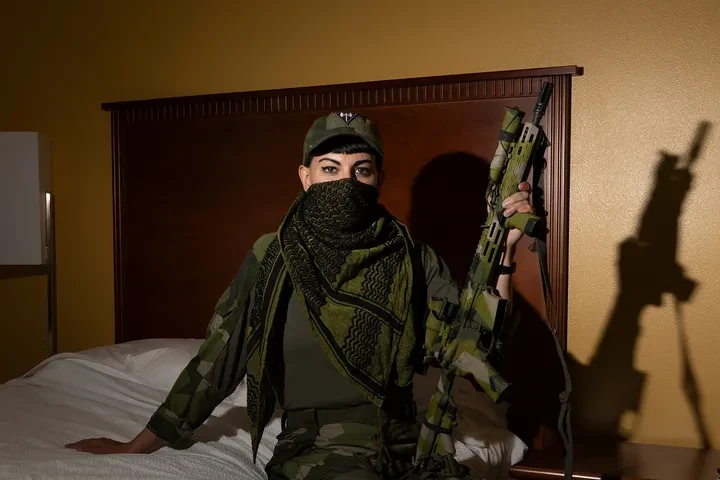
In the dimly lit hotel room she shares with two other trans women shooters, it’s easy to see why she’s built a successful audience: she knows exactly how to frame her shots for content, even with a bulky AR-15 in hand. She cuts a striking figure: her thick black brows and defined cheekbones stand out even when she covers the lower half of her face with a keffiyeh, which she wears to protect her identity.
Unlike many trans gun owners, Tacticool Girlfriend, a self-described “straight-up anarchist,” says she’s never felt explicitly turned away from mainstream shooting events. Her friend, who asks me to call her Nancy (both women requested I not use their legal names for safety), jokes that she loves visiting small towns because most people don’t clock her as trans. But she did get suspicious stares at a local gun store recently, so she played along to fit in.
“As soon as we started trash-talking Gavin Newsom, they got real friendly,” Nancy says. “It’s so annoying. It’s like, yeah, we both hate the same politicians, but we hate them for completely different reasons.”
Tacticool Girlfriend first got interested in firearms through her work as a history reenactor focusing on the Soviet Red Army, but in the lead-up to Trump’s 2016 election win, she began training seriously with modern firearms. “I could see the writing on the wall, where this country was headed,” she says. She’s already been targeted with online threats and paranoid right-wing accusations. Though she carries a gun with her at all times to prepare for worst-case scenarios, she says that doesn’t guarantee her safety—and she has no interest in seeking out conflict. “People give us way more power and malice than we actually have,” she says. “We’re just putting on fun costumes and shooting guns for enjoyment.”
At a backyard barbecue for Brutality match participants that evening, Kasarda told me about his 2021 YouTube interview with Tacticool Girlfriend. He’d found her channel, which now has nearly 67,000 subscribers, and wanted to help grow her audience. They talked about shooting competitions and “things we enjoyed.” They never even discussed trans issues, or the fact that she is trans. Even so, right-wing viewers threw a massive fit, Kasarda says.
“That whole incident made me realize there’s no fixing the old, mainstream gun community,” he says. He had to ask multiple long-time followers to leave the InRange community over the backlash, and he lost half of his Patreon income and most of his industry connections. He refuses to work with brand sponsors anyway, calling them a “corrupting influence” on content. “We’ve had to build our own path forward from scratch,” he says.
Seeing how Kasarda has rallied this diverse group of outsiders almost makes me feel hopeful for the community he’s built. But that community is about to face its biggest test yet.
In the weeks after Kirk’s killing, the right-wing backlash against trans people accelerated rapidly. I watched as the conservative outrage machine launched a full-on witch hunt for Robinson’s roommate, whom Utah Governor Spencer Cox publicly claimed is trans—a rumor that spread across social media in hours. This is despite the fact that the roommate, whom Cox called “incredibly cooperative” with investigators, has never publicly commented on their gender identity. My editors and I spent hours debating whether and how to publish this story. I thought over how photos and videos of trans gun owners are already being twisted to stoke right-wing fear, and wondered if our reporting could avoid being co-opted for that purpose.
I checked in with all my sources to see how they were processing the backlash. Every single one of them expressed wariness. There’s a shared sense that tensions can’t be de-escalated, that the right is convinced we’re already in an ideological war—one that could soon turn into real physical conflict. They’re nervous about how this story will be received, but almost all of them said they want their stories to be told accurately. That’s the least I can offer, and it feels like an effort worth making.
Bird told me that the week Kirk died, she had planned a range day to help a trans friend shop for her first gun. A couple days after the killing, she stopped by a local gun store she’d visited dozens of times to pick up ammo for the trip. “That was the most I’ve been stared at in that gun store in years,” she says. Normally, staff ask if she needs help finding anything. This time, people edged away from her and no one spoke to her. She says the first thought she had when she heard Kirk was killed was, “Oh, please don’t let it be one of us.” Even though the suspect isn’t trans, she says she and other trans people are already being punished collectively for the killing.
Even so, Bird holds onto small moments of optimism. In August, after a family member passed away, she reconnected with her grandfather—the same one who refused to accept her transition for years—at the funeral. “The first thing he said to me was ‘Jane,’ and he gave me a huge hug and used my name the whole time, and said, ‘Your grandpa’s finally come around,’” she recalls. And even though she disagrees politically with most people at her local range, she was recently surprised when a range instructor reminded all members that “the Second Amendment has to be for everyone.”
Kasarda, for his part, continues to push back against toxicity in the broader gun community. A few hours after Kirk was killed, he posted a statement on Bluesky denouncing the assassination: “Assassinations are not self nor community defense. This country is not at war, and we should all strive for